

Best Supplements for Joint Pain: Your Guide to Feeling & Moving Better
If that morning stiffness or the nagging ache in your knee is starting to get in the way of your workouts or your day-to-day life, you’re in the right place. Most of the top-tier supplements for joint pain tackle the problem from one of two angles: they either provide structural support for your cartilage or they help manage inflammation.
Some of the most researched and effective ingredients out there—like glucosamine, chondroitin, collagen, curcumin, and omega-3 fatty acids—fall into one of these two camps. They're your best bet for staying active and comfortable.
Understanding the Two Paths to Joint Relief
This guide is your practical roadmap to understanding joint health supplements here in Canada. We're going to cut through the noise and explain the science in simple, straightforward terms. Think of us as your knowledgeable training partner, here to help you find the right support whether you're a lifter in Toronto or a hiker out in the Rockies.
This isn't about miracle cures; it's about making smart, informed choices. We’ll dig into how certain compounds provide the raw building blocks for cartilage and how others help calm down inflammation, giving your body what it needs to feel and perform its best. Of course, supplements are just one piece of the puzzle. It's always a good idea to explore all the natural methods for easing joint pain for a more complete approach.
Structural Support vs. Inflammation Management
To really get a handle on joint pain, you need a strategy that gets to the root of the problem. Most of the discomfort we feel comes down to two main culprits: the physical breakdown of cartilage and persistent inflammation. The best supplements don't just put a bandage on the symptoms; they go to work on one or both of these fronts.
-
Structural Support: Think of these supplements as the construction crew for your joints. They deliver the raw materials—like collagen and glucosamine—that your body uses to build and maintain strong, resilient cartilage. This is a game-changer for anyone who puts a lot of stress on their joints, from bodybuilders to weekend warriors.
-
Inflammation Management: This is your joint's peacekeeping force. Ingredients like curcumin and omega-3s help to quiet the inflammatory signals that trigger pain, swelling, and stiffness. Getting that response under control is key to improving daily comfort and protecting your joints in the long run.
This diagram shows exactly how these two approaches work together to help you find relief.

As you can see, tackling both the structure and the inflammation is the most effective way to give your joints the support they need.
And hey, supporting your joints doesn't have to break the bank. We’ll show you how to find incredible value on top-quality brands right here at SupplementSource.ca, with fast, reliable shipping all across Canada.
Building Your Foundation with Structural Support
When you're dealing with angry joints, a great place to start is by giving your body the raw materials it needs to shore up its defences. Think of it like building a house: you need good bricks, solid mortar, and sturdy scaffolding to keep the structure sound. This is where foundational supplements come in, providing the literal building blocks for your cartilage and connective tissues.
This section covers the big four: Glucosamine, Chondroitin, MSM, and Collagen.

Glucosamine and Chondroitin: The Bricks and Mortar
Glucosamine and chondroitin are probably the most famous duo in the joint health world, and for good reason. They’re both natural parts of cartilage—the tough, springy tissue that cushions your joints.
Glucosamine acts like the "bricks," forming the basic structure of larger molecules that make up cartilage. Chondroitin is the "mortar," helping that cartilage hold onto water, which is absolutely critical for its shock-absorbing abilities.
Actionable Tip: When you're scanning labels, keep an eye out for Glucosamine Sulfate. Some research suggests it packs more of a punch than other forms like Glucosamine Hydrochloride. That sulfate part seems to be a key player in cartilage health.
For dosing, a common and well-researched starting point is:
- Glucosamine Sulfate: 1,500 mg per day
- Chondroitin Sulfate: 800 to 1,200 mg per day
You can take this all at once or split the dose throughout the day. Taking them with meals is usually a good idea to prevent any potential stomach grumbles.
MSM: The Inflammation Soother
Methylsulfonylmethane, better known as MSM, is an organic sulfur compound that’s a real team player for your joints. While glucosamine and chondroitin are busy with construction and repair, MSM is on the scene helping to calm things down.
Its main job is to help dial down inflammation and oxidative stress, especially the kind that crops up after a tough workout. If you're a dedicated gym-goer in Canada who knows post-leg-day soreness all too well, MSM can be a game-changer for your recovery.
By providing a source of sulfur, MSM also supports the formation of collagen and glucosamine, making it a perfect partner to the other supplements here. A typical dose is 1,000 to 3,000 mg (1-3 grams) per day.
Collagen: The Structural Scaffolding
If glucosamine and chondroitin are the bricks and mortar, then collagen is the steel scaffolding holding the whole building together. It's the most common protein in your body, giving strength and elasticity to everything from your skin and tendons to—most importantly for us—your cartilage.
As we get older or put our bodies through the wringer with intense training, our natural collagen production starts to dip. Supplementing can help top up your levels, giving your body the amino acids it needs to repair and maintain those crucial joint tissues.
- Type II Collagen: This is the specific type of collagen that makes up your cartilage, so you'll often see it targeted in joint health formulas.
- Hydrolyzed Collagen Peptides: This is just a fancy way of saying the collagen has been broken down into smaller, easier-to-absorb bits. Your body can put it to work much more efficiently. A great example of this highly bioavailable form is found in products like ALLMAX Collagen, a popular choice for athletes across Canada.
A standard dose for collagen peptides is around 10 to 20 grams per day. The best part? It usually comes as a flavourless powder, making it incredibly easy to mix into your morning coffee, protein shake, or even just a glass of water.
Combining these foundational supplements can create a powerful synergy, hitting joint health from multiple angles. But remember, supplements are only one piece of the puzzle. They provide the building blocks, but you still have to put in the work. Pairing them with smart, low impact strength training exercises for joint health is the key to building a truly resilient foundation.
Tackling Inflammation with Natural Compounds
While rebuilding the structure of your joints is important, it’s only half the battle. If your joints are constantly inflamed, it’s like trying to fix the foundation of a house while there's a slow burn happening inside the walls. To really get comfortable and move better, you have to put out that fire.
This is where some of nature’s most effective compounds come into play. We're not talking about just masking the pain; these ingredients work on a deeper level to help calm your body's inflammatory response. Let's dig into three of the heavy hitters: Curcumin, Boswellia, and Omega-3s.
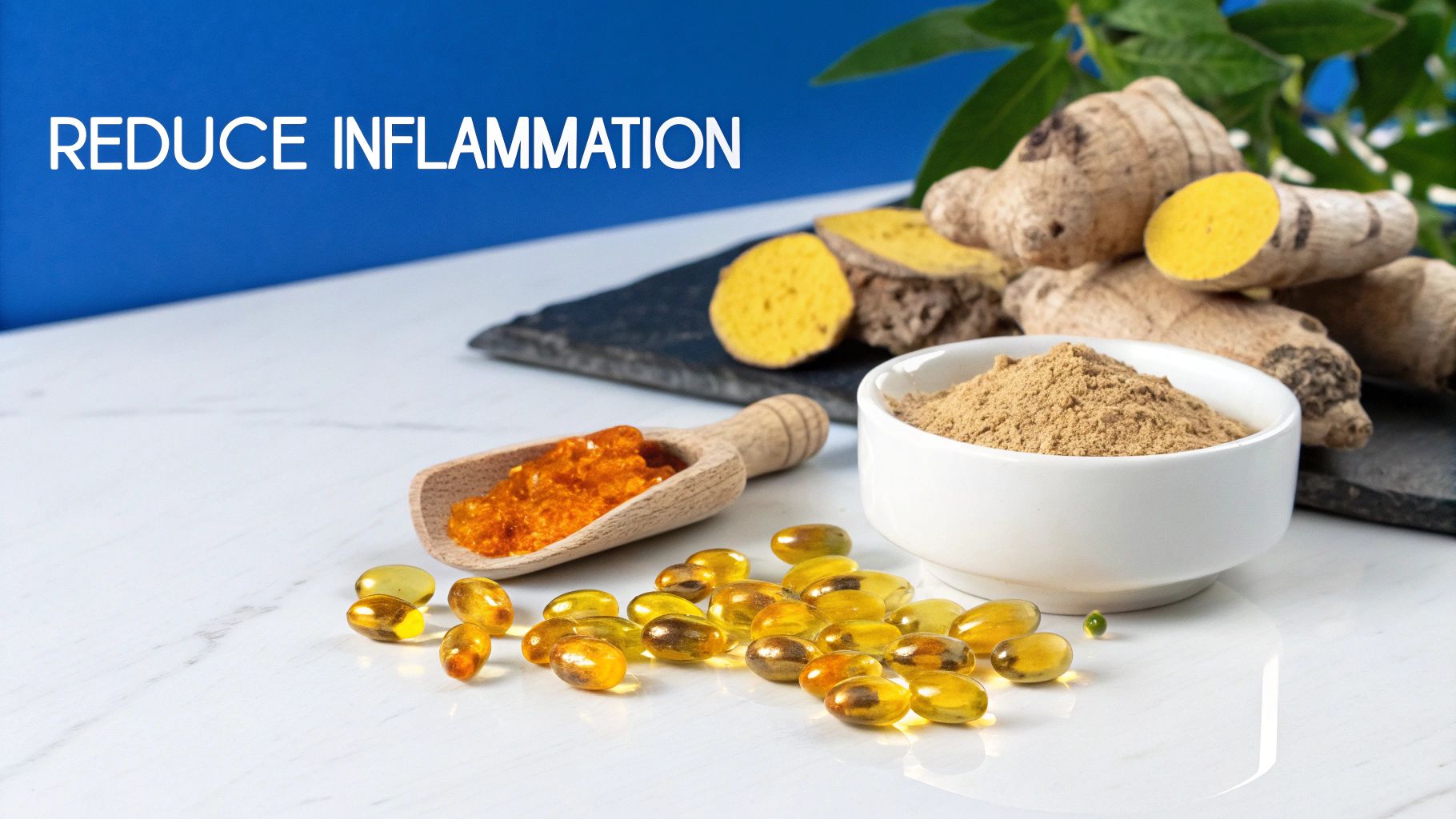
Curcumin: The Golden Anti-Inflammatory
You’ve definitely seen turmeric, the bright yellow spice that gives curry its famous colour. But the real magic inside that spice comes from an active compound called curcumin. It’s a serious antioxidant and anti-inflammatory powerhouse.
Curcumin works by helping to block specific inflammatory pathways in the body, pretty much telling your system to cool it. For anyone with overworked or aging joints, this can mean real relief from that familiar pain and stiffness.
There's a catch, though. On its own, curcumin is notoriously tough for the body to absorb. This is where a little bit of teamwork makes a huge difference.
Crucial Tip for Absorption: To get the most out of curcumin, it needs a partner: piperine, the active stuff in black pepper. Piperine can boost curcumin's availability to your body by an incredible 2,000%. Always look for a supplement that either includes black pepper extract or uses a patented, high-absorption form of curcumin.
If you're looking for a top-tier option that gets this right, a well-made product like Progressive Curcumin Turmeric offers a potent dose designed to be absorbed and put to work.
Boswellia Serrata: The Ancient Aches-and-Pains Herb
Also known as Indian frankincense, Boswellia Serrata is another ancient herb that has some impressive modern science backing it up. It’s been a go-to in traditional medicine for centuries to manage all sorts of inflammatory issues.
The active ingredients here are called boswellic acids. These compounds go to work by shutting down a specific enzyme that’s a major player in causing inflammation and pain.
What makes Boswellia so great for joints is how it targets the problem area. It helps cut down on swelling and improves blood flow right to the joints, which can lead to better mobility and less discomfort. It’s a particularly good option for people struggling with nagging knee pain.
When you're shopping for a Boswellia supplement, check the label for products that are standardized for boswellic acid content, usually around 65%. This guarantees you’re getting a consistent, effective dose. A typical dose is 300 to 500 mg, taken two or three times a day.
Omega-3 Fatty Acids: The Inflammation Balancers
Omega-3s are essential fats your body can't make itself, so you have to get them from food or supplements. For joint health, the two most important types are EPA (eicosapentaenoic acid) and DHA (docosahexaenoic acid), which you’ll find in fatty fish like salmon.
Think of omega-3s as your body's inflammation regulators. They help create compounds that resolve inflammation, bringing your system back into a healthier balance. This is a game-changer for athletes and active folks across Canada whose training can constantly trigger an inflammatory response.
Most modern diets are heavy in omega-6 fatty acids (from vegetable oils and processed foods), which can tip the scales towards inflammation. Adding omega-3s helps push things back in the right direction.
When picking an omega-3 supplement, the label tells you everything:
- Focus on EPA and DHA: Don’t get distracted by the total "fish oil" number. It’s the combined total of EPA and DHA that counts. For joint support, aim for at least 1,000 mg of combined EPA and DHA daily.
- Purity is Key: Make sure the product has been third-party tested for purity. This is your guarantee that it’s been screened for heavy metals like mercury.
Finding a high-quality fish oil supplement is simple at SupplementSource.ca, where we carry a huge selection of trusted, purified brands. And with our fast shipping across Canada, you can get the joint support you need delivered right to your doorstep.
Optimizing Joint Lubrication and Bone Health
While the big guns for joint health are things that rebuild structure and fight inflammation, a truly solid strategy has to look after the finer details, too. This means making sure your joints are well-oiled for smooth movement and that the bone underneath it all is strong and dense. Let's dig into two players that often get overlooked but are absolutely crucial: Vitamin D and Hyaluronic Acid.
Vitamin D: The Sunshine Vitamin for More Than Bones
For anyone living in Canada, the "sunshine vitamin" is a massive deal. Our long, dark winters mean a lot of us just don't get enough sun to produce the Vitamin D we need, which makes supplementing a smart call for general health. But when it comes to joint health, its role is much deeper than just helping your bones.
Yes, Vitamin D is essential for helping your body absorb calcium. Calcium is the foundation of strong bone density—the literal bedrock your cartilage sits on. If your bones are weak, the whole foundation for your joints is unstable.
But that's not the whole story. Vitamin D also plays a key part in keeping your immune system in check and managing inflammatory responses. When your levels are low, it can throw these systems out of whack, potentially making joint issues even worse.
Think of it this way: Strong bones provide a stable platform for your cartilage, and a well-regulated immune system prevents unnecessary, painful inflammation. Vitamin D helps with both, making it a non-negotiable part of any joint care routine, especially for us Canadians.
Hyaluronic Acid: The Joint's Natural Lubricant
Ever hear a joint click, pop, or grind? You've just experienced what happens when there isn't enough lubrication. This is where Hyaluronic Acid (HA) comes in—it’s your body's own super-lubricant.
Imagine HA as the premium-grade oil for your body's engine. It's a key part of synovial fluid, that thick, gel-like stuff that fills your joint capsules. This fluid does two critical jobs:
- Cushions the Joint: It acts like a shock absorber, protecting cartilage from the pounding of running, jumping, and lifting weights.
- Reduces Friction: It allows the bones in the joint to glide past each other smoothly, without that awful grinding feeling.
As we get older or put our joints through the wringer with intense training, the amount of HA in our synovial fluid can drop off. This is what leads to that "creaky" feeling and increased friction, which only speeds up cartilage wear and tear.
Taking an HA supplement helps top up these levels from the inside out, promoting better joint lubrication for smoother, more comfortable movement. It’s basically like giving your joints a much-needed oil change to keep everything running efficiently.
How to Use Hyaluronic Acid
A typical dose for oral HA supplements is around 100 to 200 mg per day. You'll often find it mixed with other helpful ingredients. For instance, pairing it with Vitamin C is a great combo, since Vitamin C is crucial for building collagen, another key piece of your joint tissue. To see how these ingredients can work together, you can find quality options like Nutridom Hyaluronic Acid with Vitamin C right here in Canada.
By adding these two supplements to your routine, you're taking a more complete approach. You're not just rebuilding cartilage or fighting inflammation; you're also fortifying the underlying bone and making sure your joints have the lubrication they need to function smoothly every single day. It's all about covering your bases for long-term joint resilience.
How to Pick a High-Quality Joint Supplement in Canada
Walking into the supplement aisle—or scrolling through pages online—can feel like a lot. Bottle after bottle makes big promises. So, how do you cut through the marketing noise and find something that actually works? Choosing the right supplement isn't just about picking the right ingredients; it's about picking the right product.
The good news is, here in Canada, we have some solid regulations that help us shop smarter. Think of this as your inside guide to becoming a savvy supplement shopper, so you can feel confident about where your money is going.
How to Read a Canadian Supplement Label
First thing's first: flip that bottle over and look for a small, eight-digit number. This is your number one clue for quality control.
- Spot the NPN: This is the Natural Product Number, and it’s issued by Health Canada. If you see an NPN on the label, it means the product has been reviewed for safety, quality, and that the health claims it makes are actually substantiated. It’s the single most important sign you’re looking at a legitimate, licensed product.
Beyond the NPN, a quick scan of the label should tell you a few other critical things:
- Active Ingredients: Does the label clearly state how much of each active ingredient is in there? For something like curcumin, for example, it should specify the amount of curcuminoids, not just the total turmeric extract.
- Recommended Dose: This tells you exactly how much to take and when.
- Risk Information: The label is required to list any warnings, potential side effects, or people who shouldn't take the product.
What Real Quality Looks Like
Here's a bit of insider info: not all formulas are created equal. A couple of key terms on a label can tell you a ton about the quality and potency of what's inside that bottle.
Key Insight: A higher price tag doesn't automatically mean a better product, but a rock-bottom price can be a red flag. Proper quality control—like third-party testing and using standardized extracts—costs money. It's an investment in your safety and in getting actual results.
Keep an eye out for these signs of a top-tier supplement:
- Third-Party Testing: Certifications from organizations like NSF or Informed-Sport are a huge plus. It means an independent lab has double-checked that the product contains what the label says it does and isn't contaminated with anything nasty. For athletes or anyone wanting total peace of mind, this is a big deal.
- Standardized Extracts: When you're looking at herbs like Boswellia or Curcumin, the word "standardized" is your best friend. It means the manufacturer guarantees a specific, consistent amount of the main active compound (e.g., "standardized to 95% curcuminoids"). This ensures you're getting a reliable, effective dose every single time.
Unfortunately, not all products on the market play by the rules. A recent study served as a powerful reminder of the risks of unregulated supplements, finding some products contained undisclosed prescription drugs that caused serious side effects. While this particular study was done in California, it's a wake-up call for all of us about the importance of sticking with tested, regulated products. You can read more about these findings and why vigilance matters.
Finding the Best Value in Canada
Looking after your joints shouldn’t have to break the bank. At SupplementSource.ca, our whole game is about making top-quality health products affordable for every Canadian. It's just how we're wired.
Here’s how you can score the best deals without ever compromising on quality:
- Calculate the Cost Per Serving: Don’t just glance at the sticker price. A little quick math goes a long way. Divide the total price by the number of servings in the bottle. This shows you the true cost and lets you compare products apples-to-apples.
- Check Out the Clearance Section: This is where you find the hidden gems. Our clearance and short-dated sections are loaded with top-brand products at seriously low prices. These products are perfectly safe and effective; they just have a shorter shelf life, making them an unbelievable bargain.
- Hit That Free Shipping Threshold: We offer fast, reliable shipping across Canada, and it’s free on all orders over $99. Planning your supplement haul to hit that number is a super simple way to save an extra $10-$15 on shipping fees.
By sticking to reputable brands that meet Health Canada's standards and being upfront with our pricing, we do the hard work for you. You can shop knowing you’re getting a safe, effective product at the lowest price in Canada—guaranteed.
Putting It All Together: Your Joint Health Action Plan
You've waded through the science and now it's time to put it all into practice. Let's build your own joint health game plan. Think of this as your personal checklist for staying active, comfortable, and strong for the long haul, whether you're hitting the gym in Halifax or hiking the trails in Banff.

Your Supplement Blueprint
Let's keep this straightforward. Your supplement choices should line up directly with what you're trying to achieve.
- For Structural Support: If your main goal is to protect and rebuild cartilage, you’ll want to prioritize ingredients like Glucosamine, Chondroitin, and Collagen. Consider these your joint's dedicated construction crew.
- For Inflammation Management: To cool down the heat of pain and stiffness, your focus should be on Curcumin, Boswellia, and Omega-3s. This is your rapid-response team, here to put out the fires.
Just remember, these supplements are a powerful tool, but they don't work in isolation. They're joining a team that already includes proper warm-ups, consistent mobility work, and, most importantly, listening to what your body is telling you.
Taking control of your joint health is an empowering step. You are definitely not alone in this; a huge number of adults lean on supplements as part of their wellness routine. In fact, data shows that over half of adults use at least one dietary supplement, and that number jumps to over 80% for women aged 60 and older. You can learn more about these supplement usage trends here.
As your trusted Canadian partner, SupplementSource.ca is here to make your journey smoother with the lowest prices in Canada, fast shipping, and a massive selection. You're now equipped to make smart, informed decisions for your joints and keep moving toward your goals.
Your Questions About Joint Supplements, Answered
We get it—diving into the world of joint supplements can bring up a lot of questions. To help you feel confident in your choices, here are some straight-up, practical answers to the most common things we hear from fellow Canadians.
How Long Until I Feel a Difference?
Patience is the name of the game here. Unlike an instant pain reliever, these supplements are all about nourishing your joints and helping them rebuild from the inside out. This isn't a quick fix; it's a long-term strategy for better joint health.
You should plan on taking a product consistently for at least 4 to 8 weeks before you even start to look for changes. For many people, the most noticeable benefits can take a few months to fully kick in as the active compounds build up in your system and get to work supporting tissue repair.
Can I Combine Different Joint Supplements?
Absolutely, and it's often a smart move. Think of it like a team effort. Stacking supplements that tackle joint health from different angles—like combining a structural ingredient like glucosamine with an anti-inflammatory like curcumin—is a common and really effective strategy.
A lot of the best all-in-one formulas do this for you, creating a blend that targets both cartilage support and inflammation at the same time. This simplifies your routine while giving you the best shot at results. Just remember to start one new supplement at a time to see how your body responds before adding another to the mix.
Should I Be Worried About Side Effects?
The great news is that the supplements we've talked about are generally very safe and well-tolerated by most people.
The most common issue, if any, is some mild digestive upset, especially with glucosamine. An easy fix for this is to simply take your supplements with a meal. And if you have a shellfish allergy, it’s critical to choose a vegetarian glucosamine source to stay safe.
When you buy from a trusted Canadian retailer like SupplementSource.ca, you're getting high-quality products that have been vetted for purity and safety. That gives you total peace of mind.
Ready to give your joints the support they deserve? Explore our massive selection of high-quality joint health supplements at Canada's guaranteed lowest prices.
Browse All Joint Support Supplements at SupplementSource.ca