

L-Citrulline Malate vs L-Citrulline: Your Ultimate Guide
You’ve seen them on pre-workout labels, and you've probably heard them thrown around the gym. But when it comes to the L-Citrulline Malate vs L-Citrulline debate, what’s the real story? It can seem a bit confusing, but making the right choice is actually pretty simple once you know what you're aiming for in your workout.
Let's cut right to it. If you want pure, unadulterated muscle pumps and maximum blood flow, L-Citrulline is your direct-action specialist. But if you’re chasing a dual-action knockout—targeting both skin-splitting pumps and muscular endurance to squeeze out extra reps—then L-Citrulline Malate is the clear winner for you.
What Is the Difference Between L-Citrulline and L-Citrulline Malate?
Staring at two tubs that both promise a better workout can leave you scratching your head. One says L-Citrulline, the other L-Citrulline Malate. They sound almost identical, but that one little word—"Malate"—makes a huge difference in how the supplement actually performs for you in the gym.
Think of it like this: L-Citrulline is a specialist, laser-focused on one job. Its primary role is to boost nitric oxide (NO) production in your body. More NO means wider blood vessels, which lets more blood, oxygen, and nutrients flood your working muscles. This is the science behind that incredible, skin-splitting pump every lifter is chasing.

L-Citrulline Malate, on the other hand, is a multi-tasker. It’s simply L-Citrulline bonded to malic acid (also known as malate). You still get all the pump-enhancing benefits of citrulline, but with an added kick. Malic acid is a key player in your body’s energy production system, known as the Krebs cycle. By supporting this cycle, it helps you generate more ATP (your muscles' fuel source), which can help you fight off fatigue and grind out those extra reps when it really counts.
Key Takeaway: L-Citrulline is for the pump. L-Citrulline Malate is for the pump and performance endurance. Your choice comes down to what you want to prioritize in your training session.
To put it in perspective for our fellow Canadians, imagine you’re training legs in the dead of a January winter. L-Citrulline is great for getting the blood flowing to warm up those muscles and deliver a satisfying pump. L-Citrulline Malate does that plus it helps you push through that last brutal set of squats when your energy starts to tank.
Here’s a quick breakdown to make the choice even clearer.
Quick Comparison L-Citrulline vs L-Citrulline Malate
This table gives you a quick overview of the main differences and the best situations to use each form of citrulline.
| Feature | L-Citrulline | L-Citrulline Malate |
|---|---|---|
| Composition | Pure L-Citrulline amino acid. | L-Citrulline bonded with malic acid (usually a 2:1 ratio). |
| Primary Benefit | Maximizes nitric oxide for intense muscle pumps. | Boosts nitric oxide and supports ATP energy production. |
| Best For | Bodybuilding, physique training, and anyone chasing the best pump. | High-volume lifting, CrossFit, and endurance-focused activities. |
| Typical Dose | 3–6 grams pre-workout. | 6–8 grams pre-workout to get an effective citrulline dose. |
Ultimately, both are fantastic ingredients. Your decision just depends on whether you're all about that pump or if you need a little extra gas in the tank to fuel your performance from start to finish.
How L-Citrulline Maximizes Your Muscle Pump
To really get into the L-Citrulline Malate vs L-Citrulline debate, you first need to understand the foundation: pure L-Citrulline. This powerful amino acid is a true specialist. It's laser-focused on one primary mission—amping up the nitric oxide (NO) levels in your body.
Now, you might be thinking, "Why not just take L-Arginine? It's the direct precursor to NO." It seems logical, but L-Citrulline is actually the smarter, more efficient route. When you supplement with L-Arginine, a big chunk of it gets broken down by your liver and intestines before it can even get to work.
L-Citrulline cleverly bypasses this metabolic traffic jam. It travels straight to your kidneys where it converts into L-Arginine. This pathway leads to a much bigger spike in your body's arginine levels, and as a result, a whole lot more nitric oxide.
The Science Of The Pump
This surge in nitric oxide kicks off a process called vasodilation, which is just a scientific way of saying your blood vessels relax and get wider. For anyone hitting the weights, from a casual lifter in Toronto to a competitive bodybuilder in Calgary, the benefits are immediate and you can feel them.
Wider blood vessels act like a superhighway for your blood flow. This means:
- Enhanced Nutrient Delivery: More oxygen, amino acids, and glucose can get to your working muscles, fuelling them for better performance.
- Improved Waste Removal: Metabolic byproducts like lactate and ammonia get cleared out faster, helping you push through fatigue.
The result is that tight, full feeling we all know as "the pump." But it's not just for looks; this cellular swelling is a signal to your muscles that it's time to grow and adapt. It's a key part of the whole muscle-building process.
Fighting Fatigue At The Cellular Level
Beyond the pump, L-Citrulline has another critical role in your performance: helping to manage ammonia. During intense exercise, ammonia builds up in your muscles, and it's a major reason you feel fatigued. It's your body's way of telling you to slow down.
L-Citrulline is a key player in the urea cycle, which is your body’s natural system for clearing out that ammonia. By supporting this process, it helps you buffer fatigue so you can maintain a higher level of performance for longer.
Practical Takeaway: Think of L-Citrulline as the ultimate blood flow specialist. Its main job is to give you the best pump possible, which in turn supports nutrient delivery and helps clear out the gunk that makes you tired.
For those focused purely on maximizing this effect, a standalone product like Tested Nutrition's Pure Citrulline gives you a straightforward, effective dose without any fluff. And if you're looking to round out your supplement stack, understanding other natural muscle-building supplements can give you a more complete approach to hitting your fitness goals.
Ultimately, by optimizing blood flow and helping manage fatigue, pure L-Citrulline sets the stage for a more productive and satisfying workout. It helps make every single rep count.
The Dual-Action Advantage of L-Citrulline Malate
While pure L-Citrulline is a specialist focused on the pump, L-Citrulline Malate is more like the versatile multi-tool in your gym bag. This isn't just citrulline with an extra ingredient sprinkled in; it's a synergistic compound where L-Citrulline is chemically bonded to malic acid. That small difference creates a huge impact on performance, shifting the focus from just blood flow to your total muscular work capacity.
Think of your body’s energy production like a factory. Pure L-Citrulline helps widen the delivery roads (your blood vessels) so more raw materials can get to the factory floor. But L-Citrulline Malate does that plus it helps upgrade the machinery inside the factory itself.
The Role of Malic Acid in Energy Production
The "malate" part of the name comes from malic acid, a natural compound found in fruits like apples. Its real magic happens deep inside your cells within the Krebs cycle—your body’s central engine for churning out ATP (adenosine triphosphate). ATP is the raw fuel your muscles burn to contract, whether you’re deadlifting or sprinting.
By supplying a key ingredient for this cycle, malic acid helps your body create and recycle energy more efficiently. This creates a powerful two-pronged attack on fatigue.
- Citrulline: Boosts nitric oxide for better blood flow, which delivers more fuel and clears out waste products faster.
- Malate: Directly supports the energy production cycle, helping you generate more fuel right where you need it.
This is exactly why L-Citrulline Malate has become a favourite for anyone doing high-volume training. Think of a punishing CrossFit WOD or a high-rep leg day; that's where this dual-action support can be the difference between hitting a new personal best and hitting the wall.
Understanding the 2:1 Ratio
When you're shopping for L-Citrulline Malate, you'll almost always see a 2:1 ratio on the label. This simply means the product contains two parts L-Citrulline for every one part malic acid. It's become the industry gold standard because it's the specific ratio used in the majority of clinical studies that showed real performance benefits.
Key Insight: A product clearly labelled "Citrulline Malate 2:1" is what you should be looking for. If a label is vague and doesn't state the ratio, you have no way of knowing how much actual citrulline you’re getting.
This ratio is also critical for calculating your dose. A 6-gram serving of 2:1 citrulline malate breaks down into 4 grams of L-Citrulline and 2 grams of malic acid. To get an effective dose, you'll need to take more total powder compared to pure L-Citrulline. A quality product like ALLMAX Citrulline Malate 2:1 clearly states its ratio, so you know exactly what you're getting and can dose with confidence.
Unfortunately, not all products deliver on their promises. One study found that only about 40% of citrulline malate supplements tested actually met their advertised 2:1 ratio. This means a lot of people were getting short-changed on the active ingredient they were paying for.
It really highlights the importance of buying from trusted Canadian retailers. Here at SupplementSource.ca, we only stock reputable brands that prioritize transparency and quality, ensuring what's on the label is what's in the tub—delivered fast, right to your door.
A Head-to-Head Performance Breakdown
Alright, we’ve covered the "what" and the "how," but now it’s time for the main event: which one actually performs better in the gym? This is where the science meets the squat rack. To really settle the L-Citrulline Malate vs L-Citrulline debate, we have to look at how they stack up in the areas that matter most: raw strength, muscular endurance, and post-workout recovery.
Let's break down the evidence and see which one takes the crown for your specific training style.
Muscular Endurance and Work Capacity
When it comes to grinding out those extra few reps that truly spark muscle growth, L-Citrulline Malate often has the edge. The malic acid component isn't just filler; it's an active player in your body's energy production cycle.
Think about it this way: you're in the middle of a gruelling set of walking lunges. Your legs are burning, your lungs are screaming, and every step feels heavier than the last. The malate in citrulline malate is working behind the scenes to help your body recycle energy more efficiently, buffering that acidic burn and pushing back fatigue. This lets you dig deeper into your sets and pile on more total training volume—a key driver of progress.
The Ultimate Pump and Blood Flow
This is where pure L-Citrulline really shines. If your number one goal is getting the most intense, skin-splitting pump possible, the pure form is your most direct route. Since it doesn’t contain malic acid, a gram-for-gram dose of pure L-Citrulline delivers more of the active ingredient responsible for kicking off nitric oxide production.
This means you can get higher peak concentrations of citrulline in your blood, leading to maximum vasodilation. For a bodybuilder focusing on that mind-muscle connection or anyone who just loves the feeling of fullness during a workout, pure L-Citrulline is the clear specialist for the job.
A fascinating double-blind trial from 2022 put this to the test with resistance-trained men. One group took pure L-Citrulline, while another took a higher dose of Citrulline Malate to make sure the actual citrulline content was equal. The results were telling. You can explore the full study on citrulline performance for a deeper dive.
Here’s a snapshot of what they found:
- Total Work Performed: The Citrulline Malate group saw a 12.4% increase in total work, just beating out the pure L-Citrulline group’s 8.7% improvement.
- Perceived Exertion: The Citrulline Malate users reported feeling 15% less exertion during high-intensity sets, hinting at a stronger fatigue-fighting effect.
- Peak Citrulline Levels: However, the pure L-Citrulline group hit significantly higher peak plasma concentrations, suggesting it's more efficient for maximizing nitric oxide.
Crucial Takeaway: Citrulline Malate seems to be the winner for banging out more reps and reducing fatigue. Pure L-Citrulline, on the other hand, is more effective at spiking blood citrulline levels for a massive pump. The "best" choice really depends on if you're chasing endurance or blood flow.
Recovery and Reducing Muscle Soreness
Both forms will help you recover, but they go about it in slightly different ways. By boosting blood flow, both L-Citrulline and Citrulline Malate help shuttle nutrients into your muscles and clear out metabolic junk after a tough session.
Citrulline Malate, however, might have an extra trick up its sleeve. Some evidence suggests that its ability to help clear ammonia and lactate more efficiently during the workout can lead to less delayed onset muscle soreness (DOMS) in the days after. If you’re an athlete in Manitoba training several days in a row and can't afford to be sidelined by crippling soreness, that small edge in recovery can make a huge difference.
The choice isn't about one being "good" and the other "bad." It's about matching the specific strengths of each compound with what you want to accomplish in the gym on any given day.
Making the Right Choice for Your Training Goals
We've covered the science and crunched the numbers, but now it's time to get practical. The real question in the "L-Citrulline Malate vs L-Citrulline" debate isn't about which one is better overall—it's about which one is the right tool for your specific job.
Let's translate this from the lab to the gym floor and figure out what makes the most sense for how you train.
Scenario 1: The Pump Chaser
Picture this: it's arm day. Your entire focus is on chasing that skin-splitting pump. You're after maximum blood flow, that tight, full feeling, and an insane mind-muscle connection. For this mission, the choice is crystal clear.
Your Best Bet: Pure L-Citrulline
Think of pure L-Citrulline as the specialist. It delivers the most concentrated dose of the amino acid that fuels nitric oxide production. This means you get the most powerful vasodilation possible, leading to the most intense pump you can imagine. It helps you feel every single rep, squeeze, and stretch.
Scenario 2: The Endurance Athlete
Now, let's say you're a CrossFitter staring down a brutal WOD, or maybe a hockey player in Alberta grinding through off-season conditioning. Your performance isn't just about the pump; it’s about your ability to fight off fatigue and keep your work rate high from the first minute to the last. You need more gas in the tank.
Your Best Bet: L-Citrulline Malate
This is where the one-two punch of citrulline malate really shines. The citrulline gets the blood flowing, but the malic acid jumps in to directly support your cellular energy cycle. It's a combination that helps you buffer fatigue, push out more reps, and recover quicker between your sets or intervals.
This simple chart breaks down the decision based on your main goal.
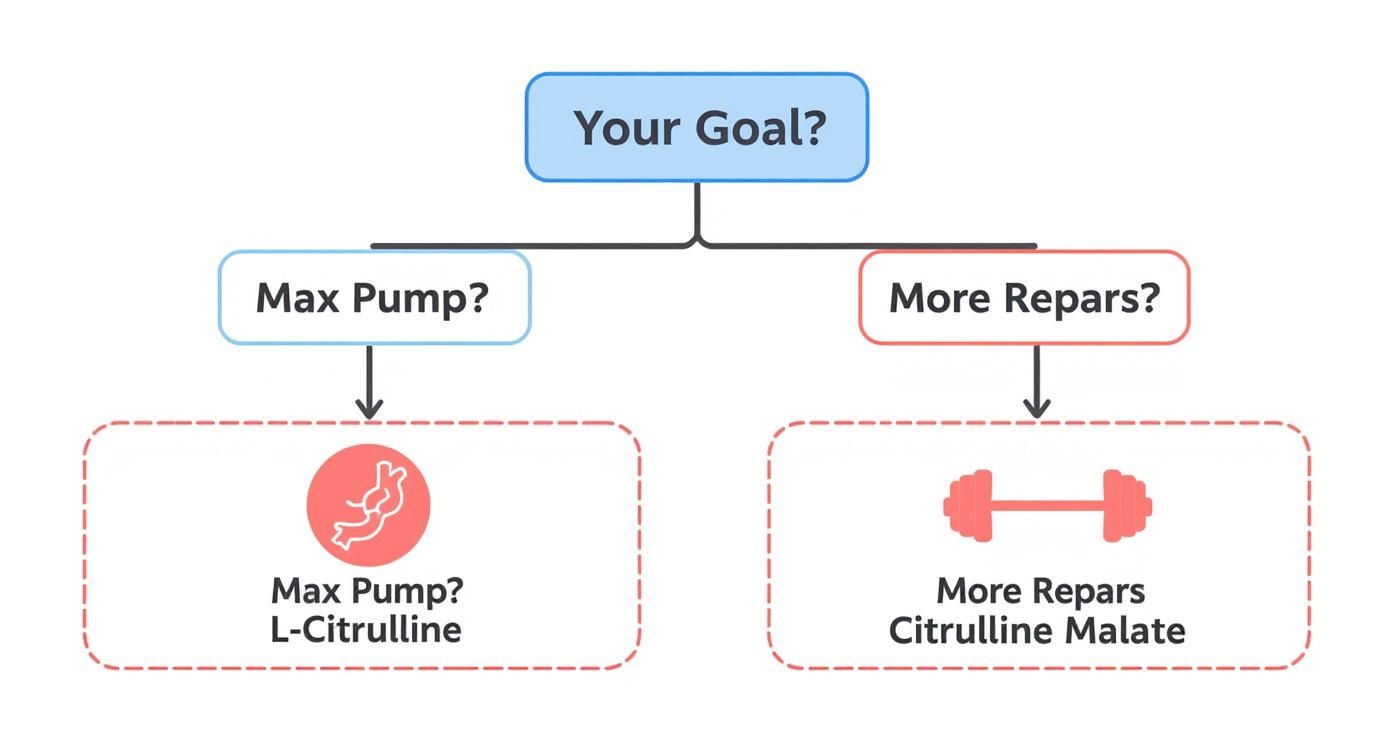
As the infographic shows, if the pump is your prize, pure L-Citrulline is the most direct route. If you’re trying to squeeze out every last rep and boost your staying power, L-Citrulline Malate gives you that critical energy advantage.
Scenario 3: The All-Arounder
What if you're like most of us at the gym? You want the best of both worlds. You love a crazy pump on upper body days, but you also need the endurance to survive a gruelling leg day. You need a versatile supplement that has your back no matter what's on the workout plan.
Your Best Bet: L-Citrulline Malate (or consider both!)
For the majority of people, L-Citrulline Malate just makes the most sense. It delivers a solid pump while also giving you a noticeable boost in performance and endurance, making it the perfect all-purpose choice. There's a good reason it's a star ingredient in so many of the best pre-workouts on the market. To learn more about what makes a pre-workout truly effective, have a look at our ultimate guide to the best ingredients in pre-workout formulas.
Pro Tip: Some serious lifters actually keep both forms in their supplement stash. They’ll use pure L-Citrulline for pump-focused upper-body days and switch over to Citrulline Malate for those high-demand, full-body sessions or leg days where endurance is king.
At the end of the day, your choice comes down to your training priorities. When you match the right supplement to your workout style, you’re making sure every scoop you take is working just as hard as you are.
How to Find Quality Supplements in Canada
Shopping for supplements in Canada shouldn't be a shot in the dark. Especially when you're weighing the pros and cons of L-Citrulline Malate vs. L-Citrulline, your best tool is simply knowing how to read a label. That's how you guarantee you're getting a product that works and isn't just a waste of money.
Walking down the supplement aisle—or scrolling online—can feel overwhelming. Both forms of citrulline are flying off the shelves, but a lot of people are still scratching their heads about what they're actually buying. One recent survey highlighted this perfectly: citrulline sales are through the roof, but a huge number of gym-goers couldn't tell you the real difference between the two, often just going by whatever the front of the tub claims.
This is where a little bit of label know-how makes all the difference.
What to Look for on the Label
To make sure you're getting an effective product, your eyes should go straight to the supplement facts panel. Here's what to hunt for:
-
The 2:1 Ratio: For Citrulline Malate, this is the gold standard and it's non-negotiable. The label needs to clearly state "Citrulline Malate 2:1". This is your guarantee that you're getting the clinically proven ratio of two parts citrulline to one part malic acid. If the label just says "Citrulline Malate," you have no real clue how much of the good stuff you're actually getting. It could be mostly malic acid.
-
Transparent Dosing: Good brands don't hide behind vague "proprietary blends." You want to see ingredients listed clearly in grams (g) or milligrams (mg). You need to know exactly how much citrulline is in each scoop. The target is 3–6 grams of pure L-Citrulline or 6–8 grams of 2:1 Citrulline Malate.
-
Third-Party Testing: Keep an eye out for seals from organizations like NSF or Informed-Sport. This is an extra layer of confidence, showing that an independent lab has verified that what's on the label is actually in the container and that it’s free of contaminants.
Key Shopping Tip: Steer clear of "proprietary blends." This is often a trick companies use to under-dose the expensive, effective ingredients. A transparent label is the first sign of a brand that actually cares about its customers.
Getting the Best Value in Canada
Being in Canada, finding top-notch supplements at a decent price with shipping that doesn't take forever is a big deal. The last thing you want is to run out of your pre-workout in the middle of a brutal winter training block. This is where exploring reputable Canadian supplement retailers can make all the difference.
And that’s exactly where we come in at SupplementSource.ca. We’ve done the hard work for you by stocking a massive selection of trusted brands with clean, easy-to-read labels. You’ll find plenty of pure L-Citrulline and 2:1 Citrulline Malate options, letting you pick the one that perfectly matches your goals and your wallet.
Speaking of wallets, our clearance section is the largest you'll find in Canada. It's the best spot to grab top-tier products that are short-dated at prices you won't see anywhere else. It’s perfect for stocking up on essentials like citrulline without feeling the pinch. Add in our fast, reliable shipping across the country, and you've got the best products at the lowest prices, delivered straight to your door.
Your Citrulline Questions Answered
We’ve gone deep into the L-Citrulline Malate vs. L-Citrulline debate, but you might still have a few things on your mind. Here, we'll tackle the most common questions we hear from fellow lifters across Canada to help you supplement with complete confidence.
Let's clear up any lingering confusion so you can get the absolute most out of every single scoop.
What Is the Most Effective Dose?
This is the number one question, and for good reason—getting the dose right is what separates a decent pump from a legendary one. The effective dose boils down to which form you're actually using.
- For pure L-Citrulline: You'll want to aim for 3-5 grams taken about 30-60 minutes before hitting the gym. This is the sweet spot for jacking up nitric oxide levels and getting that skin-stretching pump.
- For L-Citrulline Malate: You need to up the dose to 6-8 grams to really get the job done. This assumes you’re using a product with the gold-standard 2:1 ratio of citrulline to malate.
Taking it pre-workout gives the citrulline enough time to work its magic and convert to arginine, ensuring your nitric oxide levels are peaking right when you grab the bar for your first working set.
Can I Stack Citrulline with Other Supplements?
Absolutely. Citrulline is a fantastic team player and works incredibly well with other proven gym staples. Building your own pre-workout stack is a smart way to zero in on your specific training goals.
Here are a few powerhouse combos:
- With Creatine: This is the ultimate stack for strength and power. Citrulline cranks up blood flow to deliver nutrients more efficiently, while creatine fuels your muscles for those heavy, explosive reps.
- With Beta-Alanine: The perfect pairing for anyone focused on endurance. Beta-alanine helps fight off that muscle burn by buffering lactic acid, while citrulline malate kicks in to support energy production, letting you push harder for longer.
- With Glycerol: If you're chasing the most ridiculous, sleeve-splitting pump possible, this is your ticket. Glycerol super-hydrates your muscle cells from the inside while citrulline boosts blood flow from the outside, creating an intense, full feeling you have to experience to believe.
Are There Any Potential Side Effects?
One of the best things about citrulline is how safe and easy it is on the system. Both forms are known for being incredibly well-tolerated, and the vast majority of people will never experience any side effects, even at higher doses.
In very rare instances, taking extremely high doses (we're talking well over 10 grams in one go) might cause some minor stomach discomfort. This is usually only an issue for people with a particularly sensitive gut. Stick to the recommended dosages, and you'll almost certainly never have a problem.
How Can I Verify a Good Citrulline Malate Ratio?
This is a critical skill for any savvy Canadian supplement shopper. To make sure you’re not getting a watered-down product that’s more malic acid than citrulline, you need to check one key detail on the supplement facts panel.
Look for products that explicitly state ‘2:1 ratio’ right on the label. This is your guarantee that you’re getting two parts L-Citrulline for every one part malic acid. Be wary of any label that just says "Citrulline Malate" without specifying the ratio—you could be paying for a lot less of the active ingredient you actually want.
Ready to put this knowledge into action and find the perfect pump-enhancer for your goals? At SupplementSource.ca, we offer a massive selection of both pure L-Citrulline and 2:1 Citrulline Malate from Canada’s most trusted brands. Explore our collection today and find the lowest prices in the country, delivered fast to your door.