

Post Workout Protein Powder: How to Choose the Right One
You finish a hard session, towel over your shoulder, and stare at a wall of tubs. The label promises fast recovery; another product is lower in carbs; a third costs less per serving. If you train before work in Winnipeg, your next meal may be a long commute away. If you lift late in Toronto, you might be heading straight to bed. The right post workout protein powder depends less on a magic scoop and more on what you've eaten, what you can digest, and what fits your day.
Why Your Post-Workout Protein Choice Matters
After a tough workout, protein can support muscle-protein synthesis, the process your body uses to build and remodel muscle proteins. But that doesn't make a shake mandatory, or mean every lifter needs the same formula. A balanced meal can work just as well when it's available and suits your appetite.

I've seen the same choice play out in very different routines. A commuter finishing an early lift may need something portable before the drive to work. A late-evening gym-goer who ate a protein-rich dinner shortly before training may not need another full serving before bed. Their training can be equally demanding, but the practical answer changes with the day.
Three choices matter more than the hype
Start by asking how much protein you still need today. Then consider whether a shake is easier to digest or carry than food, and whether the product suits your dietary preferences and budget. Absorption speed can be a consideration, but it doesn't override your total intake or make a specific powder universally superior.
If you're unsure what to eat alongside a shake, this guide to food choices after a workout can help you think beyond the tub. Protein powder is one convenient option in a recovery routine, not a replacement for meals, sleep, or consistent training.
Practical rule: Choose a shake because it solves a real problem, such as a missed meal or low appetite, not because the clock says you've run out of time.
SupplementSource.ca is a Canadian store with a broad selection of nutrition products. The useful question isn't which tub wins a generic ranking. It's which one fits your target, your training schedule, and what you can find and afford in Canada.
How Much Protein You Actually Need After Training
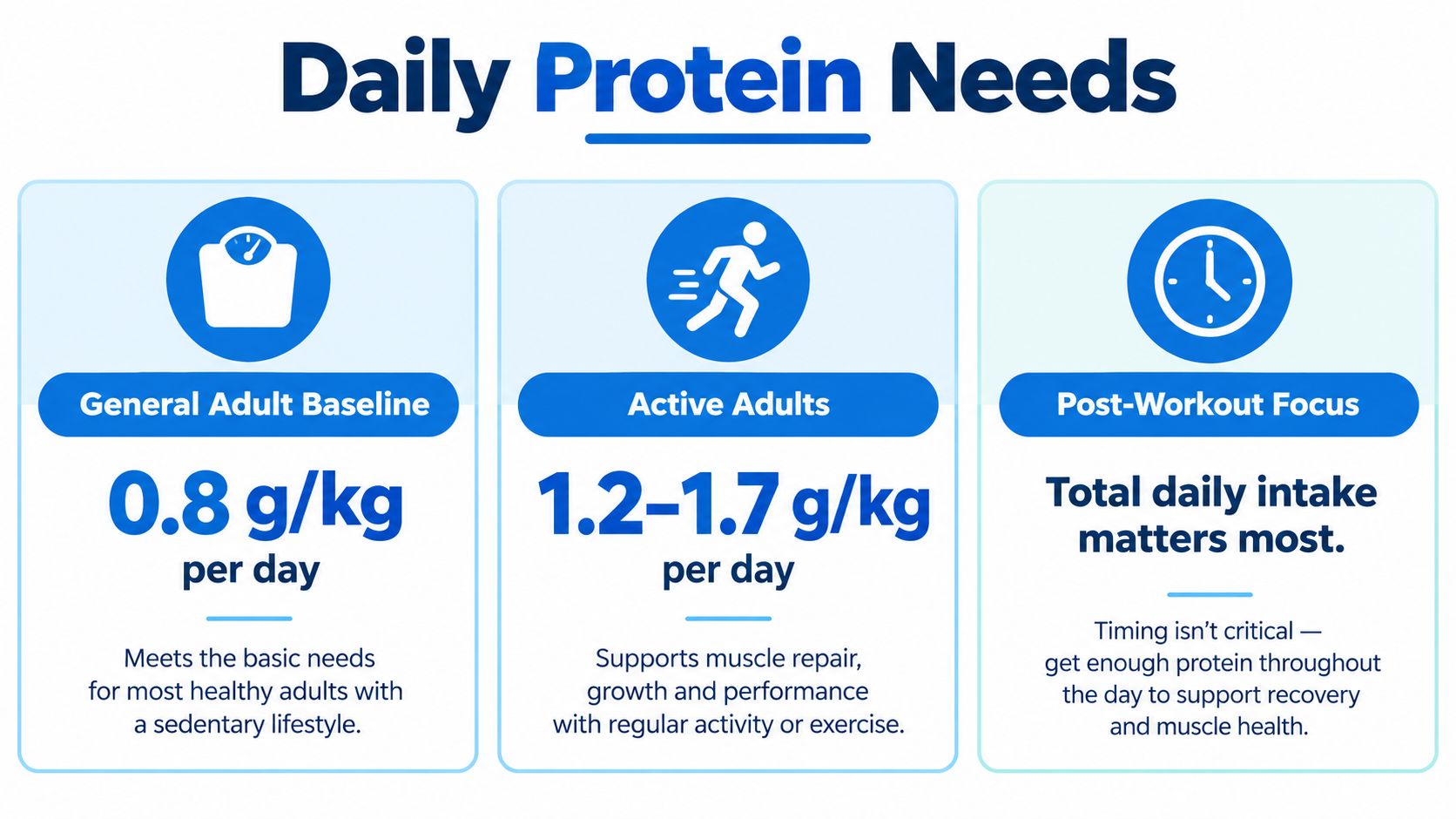
The most useful number on a protein label is the one that helps you meet your daily target. Health Canada's adult Recommended Dietary Allowance is 0.8 g of protein per kilogram of body weight per day. Canadian sports-nutrition guidance summarized by Simon Fraser University places typical targets for strength-trained athletes at approximately 1.2–1.7 g/kg/day (Canadian protein guidance).
For an 80 kg recreational lifter, the general adult baseline works out to 64 g per day. If that person trains for strength and uses the athlete range, a reasonable planning span is about 96–136 g daily. Those figures are daily totals, not amounts to cram into one shake.
Put the scoop into the day
Say you've eaten 45 g of protein by the end of training. A shake supplying 20–40 g adds to that total, leaving room to get the rest from meals and snacks. If the next meal is a chicken-and-rice dinner, you might need a smaller shake, or none. If you're heading into a long shift with limited food options, a serving may be a straightforward way to close the gap.
HealthLink BC's protein guide gives the same 0.8 g/kg baseline for healthy adults and notes that powders commonly provide 10–30 g per serving. That makes the label useful for filling a shortfall, rather than automatically doubling a scoop because you trained hard.
For another practical way to estimate your needs, use this guide to daily protein requirements. Your target can vary with training, diet, and health, so treat general figures as a starting point, not a personalised prescription.
Whey Concentrate, Isolate, Casein, and Plant Options Explained
The main protein families differ in taste, texture, ingredients, and how well they suit your diet. There isn't one winner for every lifter. Pick the type that you'll tolerate, use consistently, and feel good paying for.
Compare the common formats
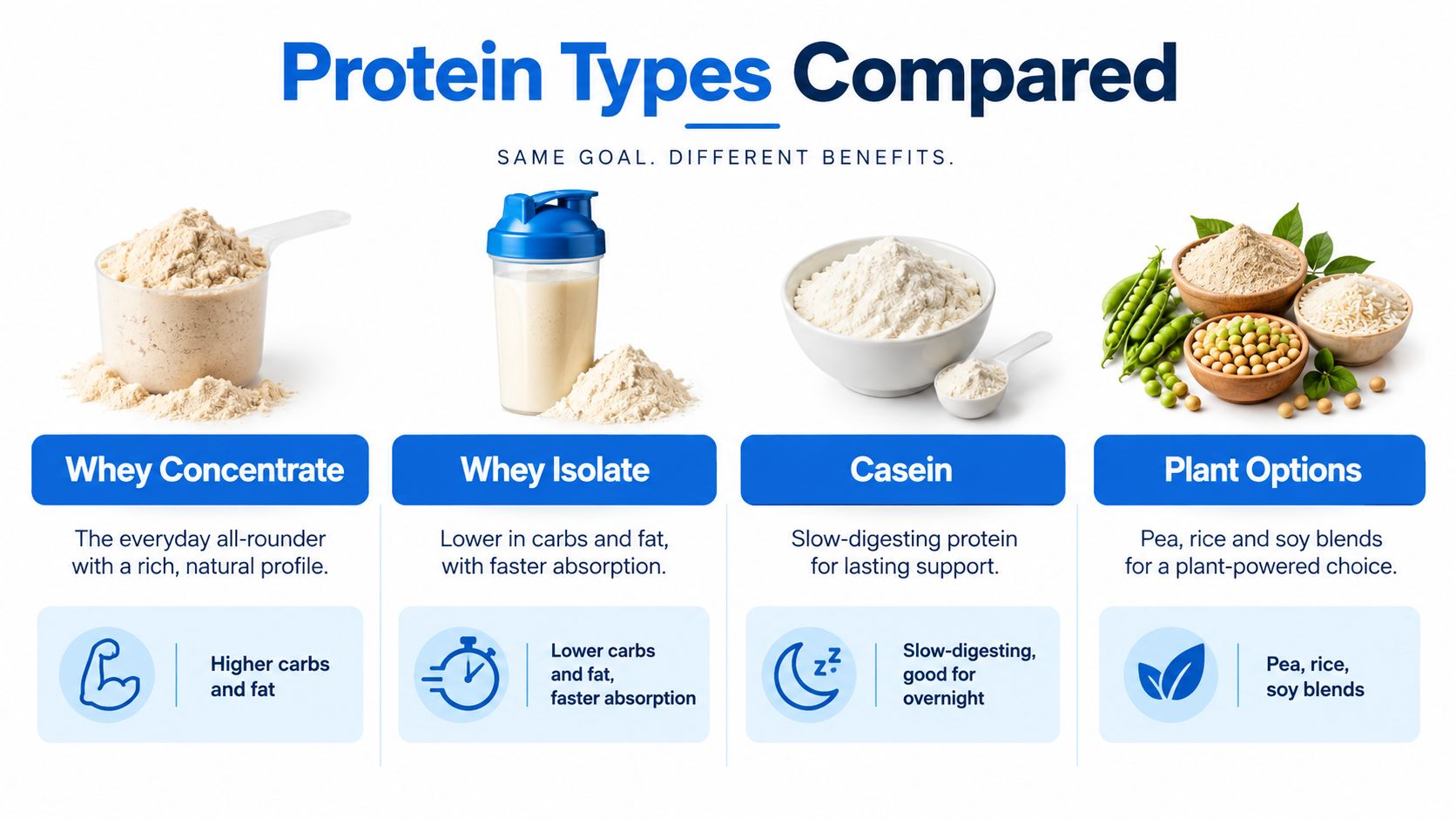
Whey concentrate is a versatile everyday choice. It generally retains more of the milk's carbohydrate and fat than isolate, and it can contain more lactose. If dairy sits well with you and you want an easy all-rounder, concentrate is often a sensible place to start.
Whey isolate is processed to reduce much of the lactose, carbohydrate, and fat. It's a practical fit when you want a leaner shake, such as while managing calories. It's still a milk-derived product, so check the ingredient and allergen information if dairy causes you trouble.
Casein is a milk protein that tends to digest more slowly than whey. Some people like it in the evening or when they expect a longer gap before their next meal. It's a preference and convenience choice, not a requirement for overnight recovery.
Plant blends can suit vegan and dairy-free diets. Pea, rice, and hemp are common ingredients; blends can combine sources to broaden the amino-acid profile. Plant powders vary in texture and flavour, so expect to try a format before settling on one.
Leucine is an amino acid involved in stimulating muscle-protein synthesis. Whey is often chosen for its amino-acid profile and quick preparation, while plant products vary by source and blend. Rather than assuming every powder delivers the same leucine or absorbs at the same speed, compare ingredient details and serving information on the actual label.
Match the format to your priorities
Concentrate often makes sense as a general-purpose option; isolate is attractive when you're watching carbs or lactose; casein suits people who prefer a thicker, slower-digesting shake; and plant blends offer a dairy-free route. Prices vary with ingredients and brand, so compare cost per serving rather than assuming one type always costs more.
Serving Size, Carbs, and When to Actually Take It
A shake should make your routine easier, not turn recovery into a maths problem. For many people, one serving with roughly 20–30 g of protein is a practical amount to count toward the day's target. Check the label: scoop sizes and protein content differ, and an oversized serving isn't automatically more useful.
Health Canada's performance-enhancer guidance notes that excess protein can be stored as fat and may cause gastrointestinal discomfort, including an upset stomach or diarrhoea. That's one reason to count your shake alongside food rather than piling on extra scoops by default.
Add carbohydrates when the session calls for them
For a standard strength workout, a protein shake can be enough if you're eating a balanced meal soon afterward. If you've completed a prolonged endurance session or a high-volume workout that draws heavily on stored fuel, pairing protein with a carbohydrate-containing meal or shake can help support recovery and fuel replacement. A banana, oats, or a sandwich alongside the shake is often more useful than paying extra for a complicated formula.
Try one of these routines:
- Early-morning session: Have a shake after training if breakfast is delayed, then eat a proper meal when your schedule allows.
- Lunch-hour lift: If lunch follows soon, make that meal the recovery meal. Add a shake only if it helps you meet your daily target.
- Late-evening block: Check what you ate before training. If dinner already supplied protein and you're not hungry, another shake may be unnecessary; if you're short and a drink feels comfortable, use one serving.
A shake delivers protein. It isn't an emergency window, and it doesn't replace the rest of your day's food.
Matching Your Post Workout Protein Powder to Your Goal
Let your goal shape the product, not the other way around. A lifter trying to gain muscle may value convenience and flavour, while someone cutting calories may prefer fewer added carbs and fats. An endurance athlete may want a shake that can be paired with a meal or a source of carbohydrate.
| Goal | Best fit | Typical serving | Carb pairing |
|---|---|---|---|
| Muscle gain | Whey concentrate or another tolerated protein source | Use a serving that helps meet your daily target | Add food or carbs if needed to make the meal more complete |
| Fat loss while preserving lean mass | Whey isolate or a lean plant blend | Choose enough protein to close the day's shortfall | Keep the shake simple; add carbs according to your wider plan |
| Endurance recovery | Whey, milk protein, or a suitable plant blend | Match the serving to your remaining daily intake | Consider a carbohydrate-containing meal after demanding sessions |
| Lactose intolerance | A suitable whey isolate or dairy-free plant protein | Follow the product's label and your tolerance | Pair with food if the workout has left you needing fuel |
| Vegan diet | Pea, rice, hemp, or a plant blend | Count its protein toward the day's total | Add a carbohydrate source when it fits the session and meal |
| Evening training | Casein, whey, plant protein, or food | Choose what feels comfortable before bed | A separate carb source isn't automatically needed |
Adults working on healthy ageing, strength, or joint-related goals can use the same basic framework: choose a protein source that fits their diet and consider overall nutrition, not just a post-workout tub. A supplement can support a routine, but it doesn't guarantee changes in muscle, strength, or joint comfort.
For a broader view of recovery habits beyond protein, this practical muscle recovery supplement routine offers another perspective to consider alongside sleep, food, and training.
Training Late and the Myth of the 30-Minute Window
The idea that you must drink a shake within 30 minutes of your last rep puts unnecessary pressure on evening trainees. Your daily protein intake and when you last ate are more useful guides than a stopwatch. If dinner included a substantial protein source before your workout, you may be well covered for the moment.
A Canadian dairy-nutrition research roundup describes a trial in which 36 healthy men consumed 45 g of whey, 45 g of casein, or a placebo before sleep after endurance exercise. Both protein groups had higher overnight muscle-protein-synthesis measures than the placebo group (research roundup on dairy and sports nutrition). That finding supports a possible pre-sleep option for late trainees, but it doesn't prove that everyone needs a large bedtime shake or guarantee strength and muscle gains. The study involved young men, so it shouldn't be treated as a direct result for adults aged forty and older.

Make the call by your last meal
If you train after dinner, first consider how much protein that meal supplied and whether you feel hungry. If you're going to bed soon and prefer a drink, a serving of whey, casein, or a plant option may be convenient. If a shake feels heavy, choose a lighter option or rely on your previous meal instead.
Shift workers and commuters can use the same rule even when their schedule isn't conventional. Ask: Did my last meal include protein? Am I still short of my daily target? Would a shake sit comfortably before sleep? Your answer matters more than the exact minute you finish training.
Reading Canadian Labels and Getting the Best Value
In Canada, workout supplements can be regulated as natural health products under Health Canada's workout-supplement framework. Health Canada says products with a suspended, cancelled, or stop-sale licence can't legally be sold in Canada (Health Canada's supplement and food guidance). Products can also be sold as foods, so the regulatory category can differ. Start with the product and licence information that applies to that category, then assess whether the powder suits your needs.
A quick label check
- Protein per serving: Compare the grams you'll use toward your daily target.
- Serving size: Check how much powder the stated protein amount requires. This guide to understanding scoop sizes can help you make fair comparisons.
- Dietary fit: Look for milk, soy, or other ingredients that matter to your allergies or preferences, and consider lactose suitability.
- Cost per serving: Compare the price against the amount of protein you get, not just the tub's front-label claims.
- Taste and mixability: Choose a format you're likely to keep using, since an ignored tub doesn't help your routine.
SupplementSource.ca is a Canadian store offering a wide variety of brands and supplement categories, with frequent promotions, clearance deals, short-dated options, and overstock savings. For shoppers comfortable with shorter best-before dates, those offers can be a practical way to save. The store also offers free shipping on orders over $99 CAD and fast, reliable shipping across Canada.
Putting It All Together and Your Next Step
Choose a post-workout protein powder by starting with your daily target, then picking a protein family that suits your training time, diet, and digestion. Read the Canadian label for serving details and product information, and compare cost per serving before deciding.
You don't need a complicated rule to recover well. A shake is useful when it fills a real gap, whether that's an early start, a late shift, or low appetite after training. When food is convenient and covers your needs, there's no need to force a powder into the routine.
Take a moment to check what you've eaten today, estimate what's left to reach your target, and decide whether a shake makes the next step easier.
Explore SupplementSource.ca's protein selection and brand variety, or look through its clearance and overstock offers for value-focused options. With free shipping on orders over $99 CAD, you can compare formats and choose a protein powder that fits your training routine and budget.