

Finding the Best Collagen Supplements for Joints in Canada
If your morning routine now includes a symphony of creaks from your knees or shoulders, you’re not alone. We’ve all been there. Think of your joints like the hinges on a well-loved door—after thousands of uses, they need a little TLC to keep working smoothly. That's where collagen comes in.
When it comes to the best collagen supplements for joints, you’re looking for formulas built around Type II collagen or a powerful blend of hydrolyzed collagen peptides. Many of the top-tier products also include teammates like Vitamin C, glucosamine, and MSM to round out the formula. These ingredients work together to give your body the essential building blocks it needs to maintain cartilage—that crucial cushioning that keeps your joints moving comfortably.
Your First Step to Better Joint Health

This guide is your no-nonsense roadmap to understanding how the right supplement can be a real game-changer for joint comfort and mobility. We'll break down exactly what collagen is—the body's main structural protein—and show you how topping up your levels can support the cartilage that cushions every move you make.
Why Collagen Matters for Active Canadians
For so many of us in Canada, being active isn’t just a weekend hobby; it's a way of life. Whether you're hitting the gym, hiking a provincial park trail, or just keeping up with a busy schedule, your joints are taking the impact. The problem is, our natural collagen production starts to drop off as early as our mid-20s, which can speed up that wear and tear.
It’s a fact of life: the body's natural collagen production begins to decrease by about 1% per year after age 20. Over time, this slow decline can lead to less resilient cartilage and the familiar feelings of joint stiffness and discomfort.
This is exactly why so many active people are turning to collagen supplements. It’s a smart, practical way to give your body targeted nutritional support to help counteract that natural decline. You’re essentially providing the specific amino acids your body needs to help repair and maintain its own connective tissues. For personalized advice on where to start with your joint health, it's always a great idea to consult with your doctor or health care practitioner.
We’re here to cut through the noise and help you find the best collagen supplements for your joints, making sure you get a high-quality product right here in Canada. At SupplementSource.ca, we carry a huge variety of trusted brands, so it’s easy to find an option that fits your goals and your budget—all with fast, reliable shipping from a Canadian company you can trust.
Understanding How Collagen Supports Your Joints
Think of collagen as the vital scaffolding that gives your body its strength and structure. It's the most plentiful protein we have, acting like the glue holding everything together—from skin and bones to, most importantly for us, your cartilage.
This firm, rubbery tissue is the shock absorber cushioning the space between your joints. Every time you squat, run, or even just walk, that cartilage provides a smooth surface, keeping your movements fluid and free from pain.
But as we get older or put our bodies through tough workouts, our natural collagen production starts to slow down. This decline can lead to thinner, less resilient cartilage, which is often the real reason behind that all-too-familiar joint pain and stiffness.
The Tire Tread Analogy
Here’s a simple way to picture what’s happening: imagine your cartilage is the tread on a car tire. When you’re young, that tread is thick and deep, giving you a smooth ride and great grip. But after thousands of kilometres of Canadian roads, that tread naturally wears down, becoming thin and less effective.
Supplementing with collagen is like giving your body the high-quality rubber it needs to patch and maintain that tread. You're supplying the key building blocks—specific amino acids like glycine and proline—that your body can use to fortify and repair your cartilage. The goal is to keep those joints properly cushioned and moving freely, just like a tire with plenty of tread left.
And this isn't just a niche concern for serious athletes. The demand for effective joint support is growing everywhere. In the West region of the USA, especially in California, the demand for collagen supplements has exploded. A 2023 survey found that 40% of American consumers are choosing collagen specifically for joint support, second only to skin health. You can read more about these collagen market trends here.
How It Works on a Deeper Level
When you take a hydrolyzed collagen supplement, it's already broken down into smaller, easy-to-absorb units called peptides. These peptides get into your bloodstream and travel throughout your body, where they can actually kickstart your own cells into producing more collagen.
It's really a two-part process:
- Providing Raw Materials: You’re giving your body a direct supply of the exact amino acids needed to build and repair connective tissues.
- Signalling for Production: These peptides also act as messengers, telling your cells (called fibroblasts and chondrocytes) to ramp up their natural collagen-making machinery.
Key Takeaway: Taking a collagen supplement doesn't just patch up holes. It provides the necessary components and encourages your body's own internal factory to get back to work maintaining your joint structures.
This process is fundamental, but collagen is just one piece of the puzzle. For a more complete strategy, it helps to know how other nutrients can work alongside it. Check out our comprehensive guide on the best supplements for joint pain to see how ingredients like glucosamine and MSM fit into the bigger picture.
By understanding how it all works, you can see why choosing a quality collagen supplement is such a proactive move. You're not just masking discomfort; you're giving your body targeted nutritional support to maintain the very structure of your joints from the inside out.
Decoding the Different Types of Collagen
Walking into the supplement aisle can feel like trying to read another language. You'll see labels shouting about "Type I & III," "Hydrolyzed Peptides," or "UC-II®," and it's easy to get lost in the jargon. This section is your decoder ring, especially if you're looking for the best collagen supplements for your joints.
While your body uses a ton of different collagens—over 16, in fact—only a handful really matter when it comes to supplements. For your knees, hips, and shoulders, one type stands out as the undisputed star of the show.
Type II Collagen: The Joint Specialist
When we talk about joint health, Type II collagen is the main event. It's the primary protein that makes up your cartilage—that firm, rubbery tissue that acts as a shock absorber between your bones. While other types are great for skin (Type I) or organs (Type III), Type II is what your body uses to keep its joint cushioning in good shape.
Think of it like building a brick wall. Type I collagen is like the standard red bricks you'd use for the whole house. But Type II is the specialized, super-durable firebrick you need to build the fireplace. For the high-stress environment of a joint, you need that specialized material.
This simple concept map shows how our joints can wear down over time and how collagen steps in as the essential repair material.
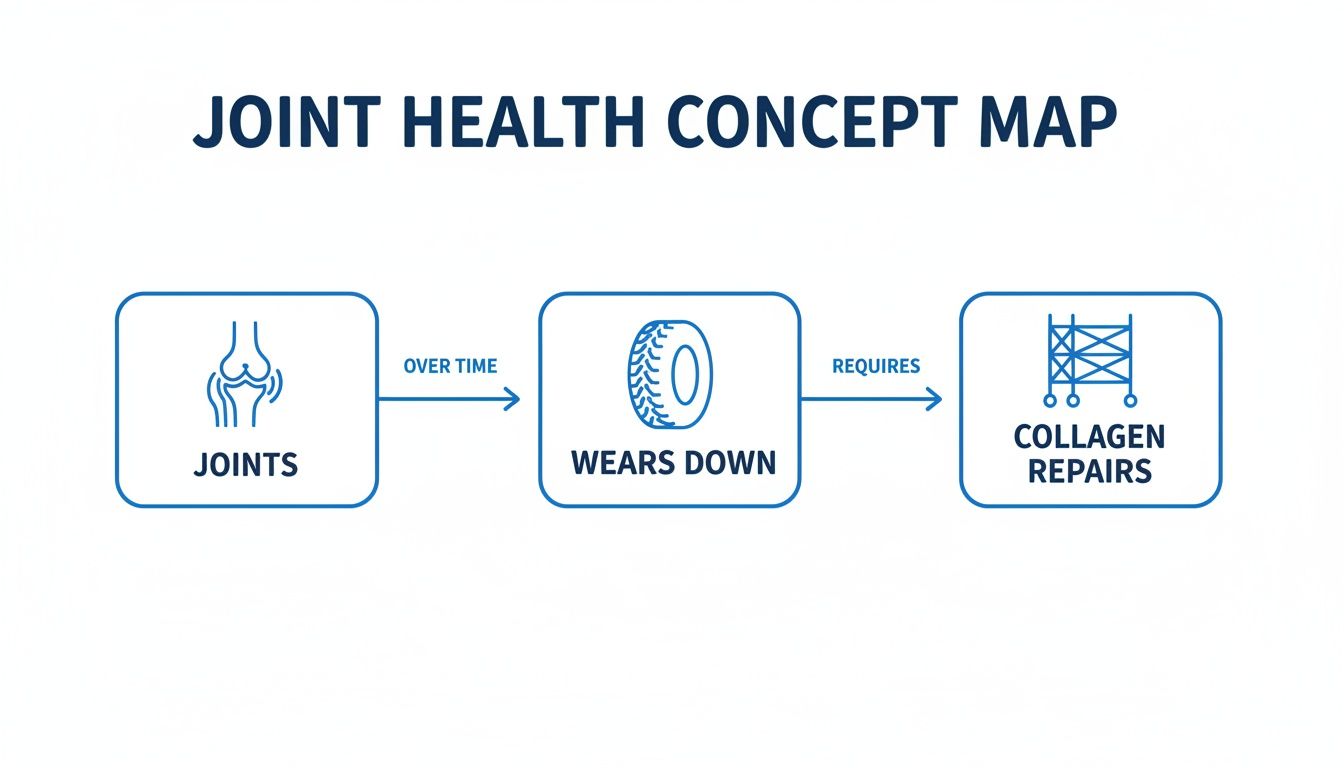
As you can see, our joints can wear down like the tread on a tire. Collagen provides the scaffolding needed for repair and maintenance, helping to keep things running smoothly.
Hydrolyzed Collagen Peptides: General Support
This is the form you'll see most often on the shelf. Hydrolyzed collagen, also called collagen peptides, has been broken down into smaller, easy-to-digest protein fragments through a process called hydrolysis.
Here’s a simple way to picture it: a whole collagen protein is like a long, tangled-up chain. Hydrolysis acts like a pair of scissors, snipping that chain into short, manageable pieces that your body can absorb and put to use almost immediately.
- Benefit: High bioavailability, meaning your body can get to work with it quickly.
- Best For: Overall wellness, including support for skin, hair, nails, and general joint maintenance.
- How it Works: It gives your body a big supply of the amino acids glycine and proline—the raw materials it needs to build its own collagen wherever it's needed.
Lots of people get fantastic results with hydrolyzed peptides because they offer such broad support. They are super versatile and dissolve easily in coffee, smoothies, or even plain water. For those who like a warm, savoury option, you might also be interested in the benefits of protein bone broth powder, another great source of collagen.
Undenatured Type II Collagen (UC-II): Targeted Action
Now for the specialist: Undenatured Type II Collagen, often sold under the trademarked name UC-II®. "Undenatured" just means the protein is left in its original, complex 3D structure—it hasn't been broken down by heat or chemicals.
This form works very differently from hydrolyzed peptides. Instead of just supplying building blocks, small doses (usually around 40 mg) interact with specialized immune cells in your gut.
This interaction helps "teach" your immune system to recognize your own cartilage as friendly tissue, which can help support a healthy inflammatory response in the joints. It’s less about rebuilding and more about regulating the joint environment.
Essentially, UC-II® helps calm things down, which lets your body's natural repair processes work more effectively. You'll often find it in dedicated joint formulas sold in capsules, designed for targeted comfort and mobility.
To make it even easier to choose, here's a quick comparison table:
Collagen Type vs. Primary Benefit
This table breaks down the different collagen forms to help you quickly decide which one best fits your goals, particularly for joint support.
| Collagen Type/Form | Primary Benefit | Best For... | Typical Daily Dose |
|---|---|---|---|
| Hydrolyzed Collagen Peptides | Provides amino acid building blocks for all tissues. | General wellness, skin, hair, nails, and overall joint health. | 10–20 g |
| Undenatured Type II (UC-II®) | Modulates immune response to support cartilage health. | Targeted joint comfort, mobility, and reducing stiffness. | 40 mg |
| Gelatin/Bone Broth | Provides cooked collagen and other nutrients. | Gut health, general wellness, and a whole-food collagen source. | Varies (e.g., 10-20 g) |
Whether you need the all-around support of a hydrolyzed powder or the targeted action of a specialized joint capsule, understanding these differences is key. At SupplementSource.ca, we carry a huge variety of both, often at Canada's lowest prices, making it simple to find what works for you.
Nutrients That Supercharge Your Collagen Supplement
While a high-quality collagen supplement is a great starting point, it doesn't work in isolation. To really get the most bang for your buck, you need to think of collagen as the star player on a team; it’s at its best when it has a solid supporting cast. Certain nutrients can seriously amplify its effects, creating a more powerful formula for your joints.
Think of it like building a brick wall. The collagen peptides are your bricks—absolutely essential for the structure. But you still need mortar to hold them together and a skilled crew to put it all in place. The nutrients we're about to cover are that mortar and crew, making sure the bricks form a strong, resilient barrier.
Understanding how these ingredients work together will help you pick a supplement that tackles joint health from every angle. This is the real secret to finding the best collagen for your joints—looking at the complete package, not just one ingredient.
Vitamin C: The Essential Cofactor
If there's one non-negotiable partner for collagen, it's Vitamin C. Your body literally cannot produce its own collagen without it. It’s a crucial cofactor in the chemical reactions that link and stabilize collagen molecules, forming the strong connective tissues your joints rely on.
Taking collagen without enough Vitamin C is like having a pile of lumber but no nails. You’ve got the raw materials, but you can’t build anything sturdy. That's why you'll see Vitamin C included in so many top-tier joint formulas; it ensures the collagen you take can actually be used by your body to help repair and maintain cartilage.
The Joint Health Veterans: Glucosamine and Chondroitin
You’ve probably seen glucosamine and chondroitin on supplement shelves for years, and for good reason. These two compounds are natural components of healthy cartilage and have a long, proven history of supporting joint comfort and mobility.
- Glucosamine: This amino sugar is a fundamental building block for cartilage. It helps your body produce other key chemicals involved in building tendons, ligaments, and the thick, cushioning fluid that surrounds your joints.
- Chondroitin Sulfate: This compound is all about hydration. It helps cartilage hold onto water, which is critical for its shock-absorbing properties. Think of it like a sponge—hydrated cartilage is plump and cushiony, while dehydrated cartilage gets stiff and brittle.
When you combine them with collagen, you get a multi-faceted approach. While collagen provides the main structural protein, these two veterans help maintain the integrity and hydration of the cartilage you already have.
MSM: A Key Supporter
Methylsulfonylmethane (MSM) is an organic sulfur compound that has earned a solid reputation in the joint health community. Sulfur is a critical mineral for maintaining healthy connective tissues, and MSM is an excellent, bioavailable source of it.
The main advantage of MSM is its ability to support a healthy inflammatory response in the joints. By helping to keep things calm and balanced, it creates a much better environment for your body’s natural repair processes to kick into gear.
It works in synergy with collagen by helping to reduce the background "noise" of joint stress, allowing the collagen peptides to get on with their rebuilding work more effectively. When you find a formula that combines collagen with MSM, you’re getting both structural support and environmental control for your joints.
At SupplementSource.ca, we stock a huge variety of these comprehensive joint formulas. You can find products that pair collagen with these key nutrients, often in our clearance section—the largest in Canada. This means you can grab a premium, multi-ingredient formula at an unbeatable price, shipped right to your door.
How to Choose the Right Collagen Supplement in Canada
Alright, you've got the theory down. You know what collagen is and why your joints need it. Now for the real-world challenge: walking down the supplement aisle (virtual or physical) and picking the right product without your head spinning.
It’s actually much easier than it looks when you have a solid game plan. Let's break down the key things to look for so you can confidently choose a collagen supplement that's effective, safe, and perfect for your goals right here in Canada.
Step 1: Source and Type
The first thing to decide is where the collagen comes from. This is a big deal because the source often dictates the type of collagen you're getting and what it’s best for. For joint health, you’ve got a few top contenders:
- Bovine (Cow): Think of this as your all-purpose joint support. It's packed with Type I and III collagen, which is fantastic for all-around connective tissue health. It’s a reliable choice for general joint maintenance.
- Marine (Fish): This one is known for being super easy for your body to absorb. While it's mainly Type I and a huge favourite for skin and hair, those building blocks are still great for your joints.
- Chicken: If achy joints are your main complaint, chicken cartilage is the MVP. It’s a naturally potent source of Type II collagen—the exact kind that forms the cushioning in your joints.
While these are the big three, the market is always innovating. Plant-based options are gaining serious traction. In fact, the vegan collagen market in the West USA is projected to grow at a huge CAGR of 10.2% through 2035, with people turning to algae- and soy-based products for joint support. If you're curious about this trend, you can discover more insights about the US vegan collagen market here.
Step 2: Form and Dosage
Next up: how do you want to take it? This is mostly about what fits your lifestyle, because both powders and capsules get the job done.
Powders vs. Capsules
Powders are the definition of versatile. You can scoop unflavoured hydrolyzed peptides into your morning coffee, a smoothie, or even your oatmeal without noticing it's there. This is the best way to get the higher doses (10-20 grams) often recommended for broad tissue support.
Capsules, on the other hand, are perfect for highly targeted formulas. We're talking about specialized ingredients like UC-II® (Undenatured Type II Collagen), where the required dose is tiny—around 40 mg. A small, easy-to-swallow pill is the ideal way to deliver it. If you can’t be bothered with mixing powders or want that precise dose for joint comfort, capsules are your friend.
Step 3: Reading the Label Like a Canadian Pro
This is where you need to put your consumer detective hat on. In Canada, natural health products are regulated by Health Canada, and knowing what to look for is non-negotiable if you want a product that's legit and safe.
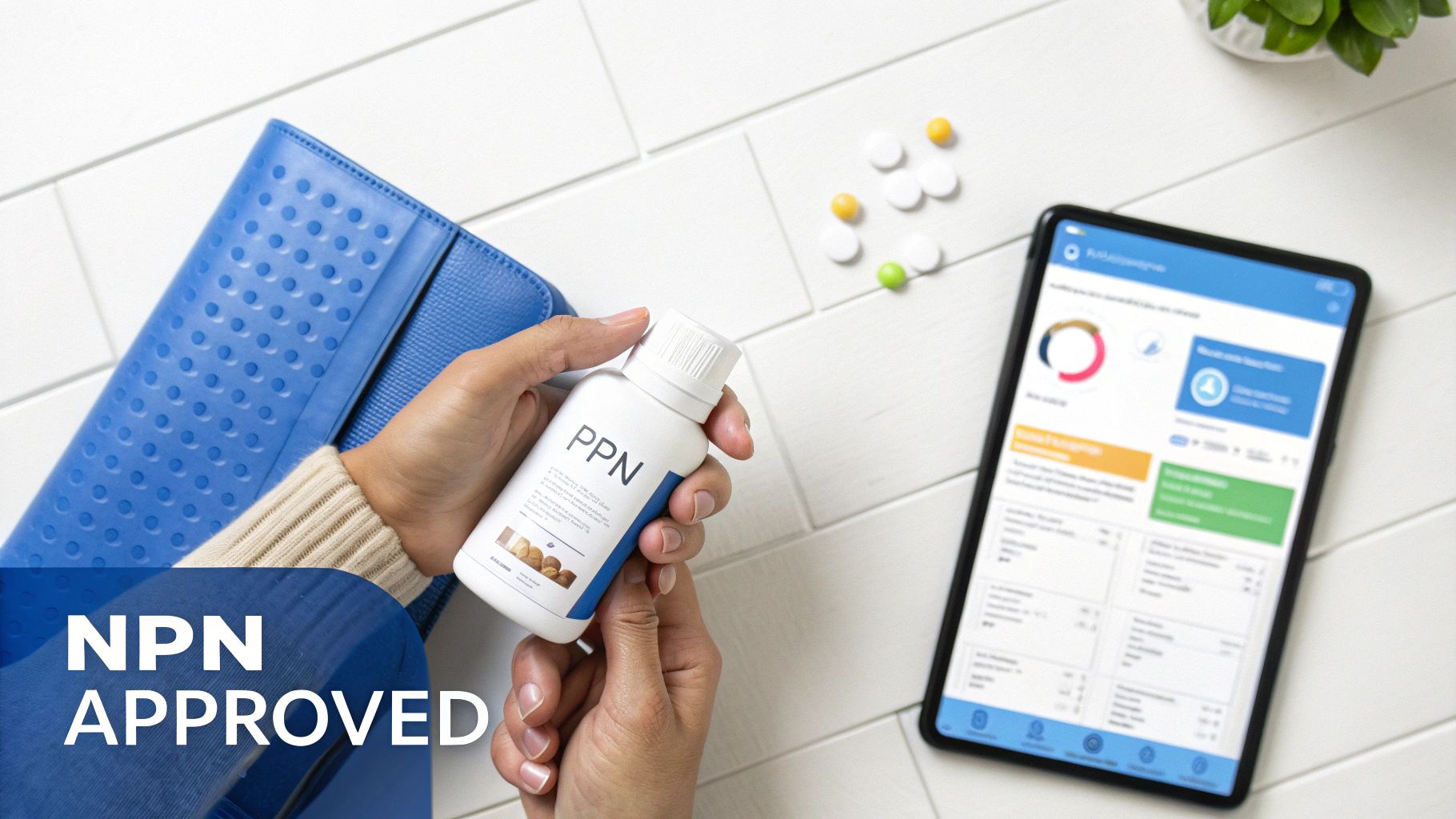
The most critical piece of information on any Canadian supplement label is the Natural Product Number (NPN). It’s an eight-digit number that proves Health Canada has reviewed the product for safety, quality, and effectiveness. If there's no NPN, it hasn't passed the test. Simple as that.
After you've spotted the NPN, look for evidence of third-party testing. Seals from organizations like NSF International or Informed-Sport are your guarantee that what's on the label is actually what's in the bottle, and that it's free from any nasty contaminants.
Making It Easy and Affordable
We get it. Juggling all these details can feel like a part-time job. That's why at SupplementSource.ca, we've already done the homework for you. We only stock trusted, NPN-approved brands, so you can shop knowing that every single product meets Canada's tough safety standards.
And finding the right joint support shouldn't cost a fortune. Our whole mission is to offer the lowest prices in Canada, period. We make that happen with killer clearance sales and overstock deals, so you can grab a top-shelf, clinically-backed formula without paying a premium.
Add in our fast, reliable shipping anywhere in Canada, and you've got the joint support you need delivered right to your door. It's all about making your health journey simpler and way more affordable.
Your Game Plan for Lasting Joint Support
Alright, let's bring this all home. You came here looking for some real answers about joint pain, and now you’ve got a solid game plan to get your mobility back on track. We've gone through what collagen is, why your joints are crying out for it, the specific types that matter, and how to pick a quality supplement right here in Canada.
If you take one thing away from all this, let it be this: consistent use of the right collagen supplement gives your body the raw materials it needs to repair and maintain cartilage. This isn't some magic overnight fix. Think of it as a long-term strategy for keeping your joints healthy so you can stay in the game—whether that means hitting a new PR at the gym or just enjoying a weekend hike without the usual aches.
Taking Action for Better Joints
Knowledge is great, but action is what gets results. The journey to smoother, more comfortable movement starts now, with your very next step. Here’s how you can get started today:
- Review Your Needs: Are you looking for the broad, all-around support of hydrolyzed peptides? Or do you need the focused, cartilage-specific action of a Type II formula? Pinpoint your goal first.
- Check the Label: Don't even think about buying a product without that eight-digit NPN. That number is your guarantee that Health Canada has given it the green light.
- Stay Consistent: This is the big one. Make taking your collagen a non-negotiable part of your daily routine, just like brushing your teeth. For some helpful pointers on making it a habit, check out our guide on how to use collagen powder.
For a more comprehensive approach, combining collagen with other therapies can make a world of difference. It might be worth looking into the role of massage in managing arthritis and joint pain as a complementary strategy.
Remember, supporting your joints is an investment in your future self. It’s an investment in your activity level and your quality of life. That small daily habit of taking collagen can pay off with huge improvements in comfort and mobility down the road.
Now’s the time to get started. Have a look through the huge selection of joint support supplements on SupplementSource.ca, put what you've learned to good use, and get ready to move with more confidence. With our killer prices and fast Canadian shipping, your path to lasting joint support is literally just a click away.
Frequently Asked Questions About Collagen for Joints
We get a ton of questions about using collagen for joint health, especially from Canadians trying to stay active through our wild seasons. To cut through the noise, here are some straight-up answers to the most common things people ask.
How Long Does It Take for Collagen to Help Joint Pain?
This is where patience and consistency really pay off. While some folks might notice a difference in a few weeks, the science points to a solid 3 to 6 months of daily use to see significant improvements in joint comfort and mobility.
Think of it like building a house, not putting out a fire. You're giving your body the raw materials it needs to slowly rebuild and reinforce your cartilage. Sticking with it every single day is the key—that steady supply is what allows your body to do the repair work properly.
Can I Mix Collagen with My Protein Shake?
Absolutely—and it’s a brilliant move, especially if you're hitting the gym.
Collagen has a completely different job to do than your typical whey or plant-based protein. While your regular protein shake is loaded with BCAAs for muscle growth, collagen is packed with amino acids like glycine and proline. These are the specific building blocks for your connective tissues—cartilage, ligaments, and tendons. Tossing a scoop of unflavoured collagen peptides into your post-workout shake is an easy way to cover all your bases, supporting both muscle recovery and joint resilience at the same time.
Is Marine or Bovine Collagen Better for Joints?
Great question. The answer really depends on what you're trying to achieve.
Both marine and bovine collagen are fantastic for overall health. Bovine is rich in Type I and III collagen, which is great for your skin, bones, and general tissue repair. Marine collagen is mostly Type I and is known for being absorbed very easily by the body.
For a targeted approach to joint health, though, supplements sourced from chicken cartilage often have the edge. That's because chicken cartilage is a naturally concentrated source of Type II collagen—the main protein that makes up your actual joint cartilage. For general wellness, both marine and bovine are solid choices. For specific joint goals, a formula featuring Type II is your best bet.
Are There Any Side Effects of Taking Collagen?
Collagen is widely considered very safe and most people tolerate it without any issues at all. Since it's basically a food-derived protein, side effects are pretty rare.
Once in a while, some people might experience a bit of mild digestive upset, like feeling overly full, but this is uncommon. If you're concerned, you can always start with a smaller dose to see how your body handles it.
The most important thing is to choose products from a reputable Canadian retailer like SupplementSource.ca that only stocks brands with an NPN (Natural Product Number). An NPN means the product has been reviewed by Health Canada for safety, quality, and efficacy, giving you peace of mind with every scoop.
Ready to give your joints the support they deserve? SupplementSource.ca has a massive selection of the best collagen supplements for joints, all at the lowest prices in Canada.
Explore our Joint Support Collection and find your perfect match today!