

Hydrolysed Whey Protein: Your Guide to Faster Muscle Recovery
Ever wonder what the difference is between the protein powder you use and the high-tech stuff pro athletes swear by? Often, the answer is hydrolysed whey protein.
Think of it as a pre-digested version of whey that your body can absorb almost instantly. Its biggest selling points are lightning-fast absorption and being incredibly gentle on the stomach. This makes it the go-to choice for serious athletes, anyone with a sensitive digestive system, and lifters who want to maximize every second of their recovery window.
The Science Behind Super-Fast Protein
Ever try to untangle a massive, knotted ball of yarn? It takes a while. Regular whey protein is a bit like that tangled ball—your digestive system has to put in some serious work to break down the long, complex protein chains before your body can actually use them to build muscle.
Hydrolysed whey, on the other hand, is like getting that yarn already snipped into short, ready-to-use pieces.
This "pre-digestion" happens through a process called hydrolysis. Manufacturers use specific enzymes to essentially do the heavy lifting for you, breaking the bonds holding the long protein chains together. What you're left with are smaller fragments called peptides.
Key Takeaway: Hydrolysis does a chunk of the digestive work for you before the protein even hits your shaker cup. This means the amino acids can get into your bloodstream and out to your muscles much, much faster than with standard whey.
Why Speed Matters for Your Fitness Goals
Picture this: you’ve just wrapped up a brutal leg day in the middle of a tough Canadian winter. Your muscles are screaming for repair. The faster you can get the building blocks (amino acids) to those muscles, the quicker the recovery process can kick into high gear. This lightning-fast delivery is the main reason to invest in hydrolysed whey.
Here’s what that actually means for your training:
- Faster Recovery: It kick-starts muscle protein synthesis—the body's process for repairing and rebuilding muscle tissue—almost immediately after your workout.
- Reduced Soreness: By getting those nutrients to your muscles in record time, it can help take the edge off the dreaded delayed onset muscle soreness (DOMS). Less time wincing, more time training.
- Easier Digestion: If you’re one of those people who feels bloated or just "off" after a regular protein shake, hydrolysed whey is often the perfect solution. Its pre-digested nature is famously easy on the gut.
For competitive athletes hitting two-a-days or just anyone with a sensitive stomach, this isn't some minor upgrade; it's a real strategic advantage. It lets you fuel your body efficiently without any digestive lag, helping you bounce back and be ready to crush your next session at full strength.
Comparing Hydrolysate, Concentrate, And Isolate
Walking into a supplement store (or browsing online) can feel like a pop quiz you didn't study for. You see whey concentrate, isolate, and hydrolysate lined up, but what’s the real story behind the labels?
Let’s use an analogy. Think of it like choosing fuel for your car: concentrate is your trusty regular gas, isolate is the cleaner-burning premium stuff, and hydrolysed whey protein is straight-up rocket fuel. Each one will get you where you're going, but they perform very differently based on how refined they are.
Your final choice really boils down to your specific goals, your budget, and how well your body gets along with dairy.
Whey Protein Showdown: Concentrate vs. Isolate vs. Hydrolysate
To make things crystal clear, let's put these three whey warriors side-by-side. This table breaks down the key differences to help you figure out which one is the right fit for your fitness journey, your wallet, and your digestive system.
| Feature | Whey Concentrate | Whey Isolate | Hydrolysed Whey |
|---|---|---|---|
| Protein Content | 70-80% | 90%+ | 90%+ |
| Lactose & Fat | Low | Very Low / None | Very Low / None |
| Absorption Speed | Moderate | Fast | Ultra-Fast |
| Digestion | Good for most | Great for sensitivity | Easiest on the stomach |
| Best For | General use, beginners | Low-carb diets, lactose sensitive | Pro athletes, rapid recovery |
| Price Point | Most affordable | Mid-range | Premium |
As you can see, there isn't one "best" option—just the best one for you. It's all about matching the protein's profile to your personal needs.
Protein Purity And Lactose Content
The main thing that separates these proteins is how much filtering they go through.
Whey concentrate is the least processed of the bunch. It typically contains 70-80% protein by weight, with the rest made up of a bit of lactose (milk sugar) and fat. For most people, this is a perfectly solid choice.
Whey isolate takes it a step further. It goes through an extra filtration process, called cross-flow microfiltration, that strips out nearly all the lactose and fat. What's left is an incredibly pure product that’s 90% or more protein. This makes it a go-to for anyone on a strict diet or with some lactose sensitivity.
Hydrolysed whey usually starts its life as a high-quality isolate and then gets the hydrolysis treatment we covered. This means you get that same super-high protein purity, but with the game-changing benefit of it being pre-digested.
This is a great visual of how hydrolysis takes large, complex protein chains and chops them up into smaller, easy-to-absorb pieces.
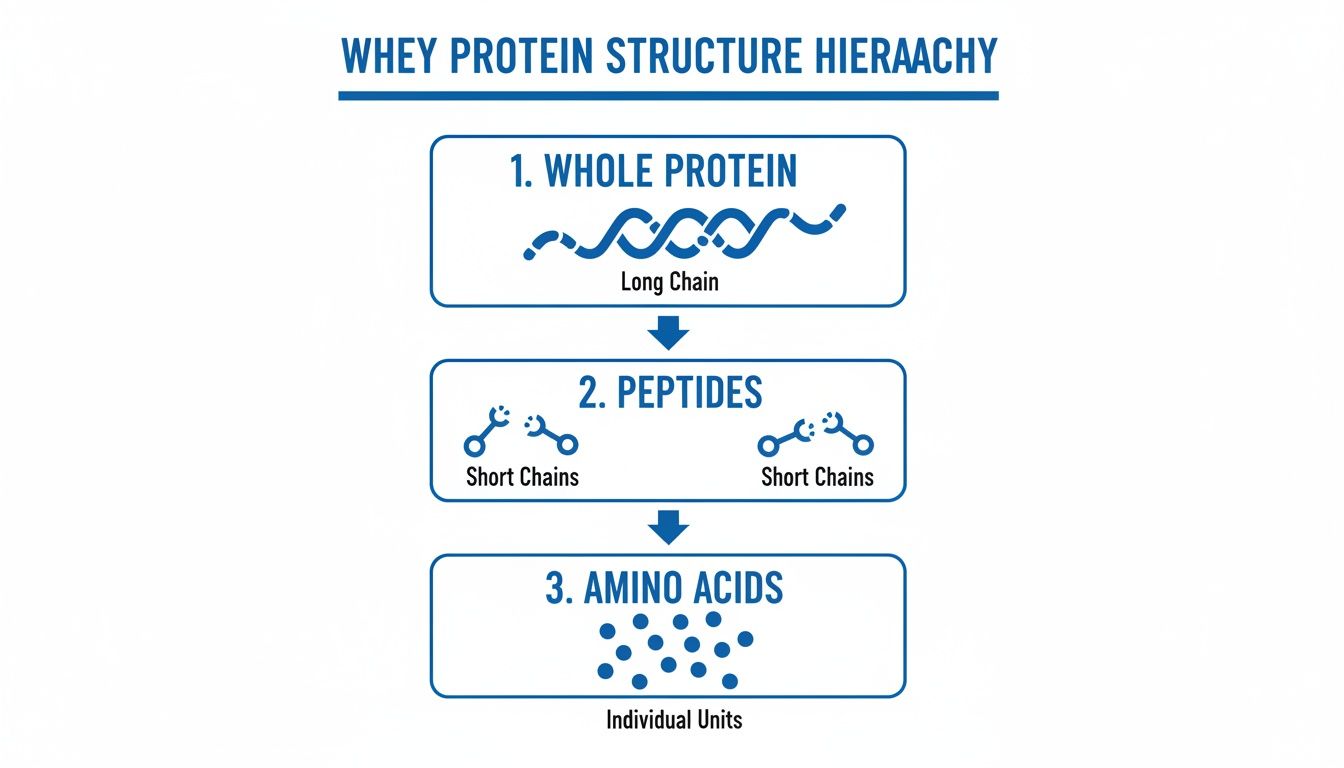
As you can tell, the process simplifies the protein's structure, taking a huge workload off your digestive system.
Absorption Speed And Price
This is where that "rocket fuel" analogy really hits home.
Because hydrolysed whey is already broken down, your body can absorb it almost instantly. Research has shown it can spike amino acid levels in your bloodstream much faster than both concentrate and isolate.
This rapid-fire delivery makes hydrolysed whey protein the undisputed champ for post-workout recovery. For serious athletes where every minute of muscle repair counts, it’s a non-negotiable.
Of course, this advanced processing comes with a higher price tag. Concentrate is the most budget-friendly option and a fantastic starting point. Isolate sits comfortably in the middle, offering a sweet spot of purity and value. Hydrolysate is the most expensive, and that cost reflects the sophisticated manufacturing behind it.
Want to go even deeper? We've laid out all the details in our ultimate guide to whey protein variants.
Here at SupplementSource.ca, we believe everyone should have access to the protein that works for them. Our huge clearance section often has unbelievable deals on top-shelf isolates and hydrolysates, so you don't always have to pay a premium price for premium fuel. We're committed to giving Canadians the best prices, no matter which type of whey they choose.
How Hydrolysis Speeds Up Muscle Recovery
Let's get right down to the science of speed. The whole point of hydrolysis is to give your body a massive head start on digestion. Think of it like a chef who preps and chops every single ingredient before the dinner rush hits—it makes the final cooking time ridiculously fast.
By breaking down long, complex protein chains into much smaller, simpler fragments called peptides, the hydrolysis process does most of the heavy lifting for your digestive system. This allows those peptides to bypass the usual digestive traffic jam and get absorbed into your bloodstream almost instantly.
The result? A massive, rapid spike in your blood amino acid levels. This flood of building blocks is exactly what your muscles are screaming for to kickstart muscle protein synthesis—the technical term for the repair and rebuilding process—the second you finish that last gruelling rep.
Making The Most Of The Anabolic Window
You've probably heard about the "anabolic window," that critical period right after a workout when your muscles are like sponges, primed to soak up nutrients. Hydrolysed whey is the ultimate tool for this window because it hits your system with incredible speed.
Picture a hockey player deep in a tough Canadian tournament season with back-to-back games. They need to recover as fast as humanly possible, period. A regular protein shake might take an hour or more to fully break down, but a hydrolysed whey shake can start delivering amino acids to their muscles in as little as 15-30 minutes.
That rapid delivery means less time feeling sore and more time spent actually repairing muscle tissue. When every second of recovery counts, that's a game-changing advantage.
By getting amino acids to muscle tissue faster, hydrolysed whey helps kick off the repair process almost immediately, which can seriously reduce the severity of delayed onset muscle soreness (DOMS).
Practical Benefits For Canadian Athletes
For any Canadian athlete, this speed isn't just a cool feature; it’s a strategic edge that you can use to your advantage, no matter the training season.
- During Intense Training Blocks: When you're redlining it—think a bodybuilder in peak week or a CrossFitter prepping for a competition—your body's demand for nutrients is off the charts. Hydrolysed whey meets that demand instantly.
- For Sensitive Stomachs: Let's be real, pushing your limits can sometimes lead to digestive stress. Because it’s essentially pre-digested, hydrolysed whey is incredibly gentle on the gut, ensuring you get your protein without any bloating or discomfort.
- When Time is Tight: For the busy professional cramming in a workout before heading to the office, fast absorption means you’re refuelling efficiently without any digestive lag slowing you down.
To really dial in your body's healing, especially when dealing with intense training cycles or minor tweaks, understanding all your recovery options is key. For example, looking into the best treatment for muscle strain can provide valuable insights. Properly caring for your body is a non-negotiable part of any serious fitness plan. For a deeper dive, check out our guide on other great supplements for muscle recovery.
Who Actually Needs Hydrolysed Whey?
Look, anyone can use hydrolysed whey protein. But let's be real—it’s not your everyday, all-purpose supplement. Think of it less like your reliable daily driver and more like a finely-tuned race car. It’s incredibly powerful, but you only bring it out when you need that extra gear.
So, who really gets their money's worth from this premium protein? Let's break down who benefits the most. You might just see yourself in one of these profiles.
The Competitive Athlete
Picture this: you're a hockey player battling through a weekend tournament, or maybe a CrossFitter hitting multiple WODs in a single day. You’ve only got a few hours, max, to recover between punishing sessions. This is where hydrolysed whey truly shines.
Its ridiculously fast absorption means you’re kickstarting muscle repair almost instantly. For athletes in these situations, it’s not a luxury; it's a vital part of the recovery plan to help them bounce back and perform when it counts.
Anyone With A Sensitive Stomach
You’ve just crushed a workout. You know you need protein, but the thought of chugging a heavy, milky shake makes your stomach churn. It’s a common problem—bloating, gas, and general discomfort from standard protein powders.
Since hydrolysed whey is essentially "pre-digested," it's known for being incredibly gentle on the gut.
If you're one of those people who gave up on protein shakes because they just don’t sit right, hydrolysed whey could be the game-changer you've been searching for. It gives you all the high-quality protein you need without the digestive drama.
The Hardgainer
For those of us who fight for every pound of muscle, every single calorie and gram of protein is precious. The big challenge for a hardgainer is cramming in enough fuel without feeling perpetually stuffed and bloated.
Hydrolysed whey's light consistency and speedy absorption let you get a quick, effective protein hit without feeling weighed down. This makes it easier to fit in more meals or shakes throughout the day—a must for creating the calorie surplus needed to grow. For a deeper dive on this, our guide explains how much protein you need to build muscle.
The Post-Workout Maximizer
This is the person who has their nutrition dialled in to the minute. You track your macros, time your nutrients, and want to squeeze every last drop of progress out of your training. Using hydrolysed whey in that critical post-workout "anabolic window" ensures you're firing up muscle protein synthesis as efficiently as humanly possible.
Going beyond just the product, integrating it effectively with personal nutrition coaching strategies can help you dial in your results even further.
No matter which camp you fall into, we’ve got your back at SupplementSource.ca. We know top-shelf proteins come with a top-shelf price tag. That’s why our massive clearance section is a lifesaver for Canadian athletes. You can often find elite hydrolysed whey from major brands at the lowest prices in the country, putting pro-level recovery within everyone’s reach.
How To Read The Label On Hydrolysed Protein
Flipping over a tub of hydrolysed whey protein can feel like you need a science degree to understand it all. With terms like "peptides" and "degree of hydrolysis," it's easy to get lost. But learning to decode that label is your best tool for making sure you’re getting exactly what you pay for—pure, fast-acting protein.

Let’s turn you into a savvy supplement detective. When you pick up a product, the first thing to check is the ingredients list. You want to see “hydrolysed whey protein isolate” right at the top. This confirms the main protein source is the purest form of whey, which was then put through the hydrolysis process for maximum absorption.
Understanding Degree of Hydrolysis (DH)
This is a term you might spot on more premium labels. The Degree of Hydrolysis (DH) is a percentage that tells you how extensively the protein has been broken down. A higher DH means smaller peptides and faster absorption, but it can also lead to a more bitter taste.
Think of it like chopping vegetables. A low DH is like a rough chop, while a high DH is a fine dice. Most top-tier products balance a high DH for speed with advanced flavouring systems to make it taste good. While not every brand lists the DH, the ones that do are showing a real commitment to transparency.
Red Flags To Watch Out For
Knowing what to look for is only half the battle; you also need to know what to avoid. A quality hydrolysed whey protein should have a clean, simple ingredient panel. Be wary of a few things:
- Proprietary Blends: If you see a "special protein matrix" or a blend that doesn't specify how much hydrolysate is inside, put it back. This is a common tactic used to hide the fact that the product contains very little of the expensive hydrolysed protein, padding it out with cheaper concentrates instead.
- Excessive Fillers: A long list of gums, thickeners, and artificial ingredients can be a sign of a lower-quality product. The protein itself should be the star of the show.
- Misleading Names: Just because the name on the front says "Hydro," doesn't mean it's a pure hydrolysate. Always trust the ingredients list on the back, not the marketing hype on the front.
The bottom line is to demand transparency. You’re investing in a premium product, and you deserve to know precisely what’s in every scoop. This is why shopping with a trusted Canadian retailer like SupplementSource.ca is so important. We stock brands that are known for their quality and transparency.
Plus, our commitment to offering the lowest prices in Canada means you can get these high-end, trustworthy products without breaking the bank. By learning to read the label, you can shop our clearance deals with confidence, knowing you’re getting both incredible value and a top-quality hydrolysed whey protein.
Is Hydrolysed Whey Worth the Price?
Alright, let's get real about the price tag. Hydrolysed whey protein is a top-shelf product, and it costs a bit more. It’s definitely not the right fit for absolutely everyone, so let's figure out if it's a smart buy for you.
If you're a casual gym-goer who hits the weights a few times a week, a high-quality whey isolate will give you fantastic results and be much easier on your wallet. It's pure, effective protein for building muscle without needing to splurge.
But for some people, that calculation looks a little different.
When The Extra Cost Makes Perfect Sense
For a few key groups, the higher price of hydrolysed whey isn't just a cost—it's a direct investment in performance and feeling great.
- Competitive Athletes: Anyone training twice a day or needing to recover fast between events knows that every minute counts. The super-quick absorption isn't just a nice-to-have; it's a must-have tool for bouncing back.
- Individuals with Digestive Issues: If regular whey sometimes leaves you feeling bloated or uncomfortable, hydrolysate can be a total game-changer. Its pre-digested nature means you can get your protein in without the gut-ache.
- Performance Maximizers: For those who track every last detail of their nutrition and training, hydrolysed whey offers that final edge. It helps you get the absolute most out of that post-workout anabolic window.
For these folks, the extra cash isn’t just for a supplement. It’s an investment in faster recovery, digestive comfort, and the ability to get back to training harder, sooner.
The demand for hydrolysed whey in Canada has been growing strong, with powders being the most popular choice because they're so versatile. In fact, North America (including Canada) makes up 30% of global demand, thanks to the boom in sports nutrition. This is great news for Canadian shoppers because it means plenty of options and competitive prices. You can dig into more details about the Canadian whey protein market on ResearchAndMarkets.com.
And this is where shopping with us at SupplementSource.ca gives you a huge advantage. Our clearance section and short-dated deals can slash the price, bringing this "rocket fuel" protein into reach for more people. You get all the benefits of a premium product at a price that actually makes sense.
Common Questions About Hydrolysed Whey
Let's tackle some of the most common questions we hear from our Canadian customers about hydrolysed whey. Getting straight answers will help you figure out if it's the right choice for your fitness and recovery goals.
Does Hydrolysed Whey Protein Taste Bad?
This is a classic question, and honestly, it used to have a reputation for being bitter. That bitterness was a direct result of the hydrolysis process itself.
But here’s the good news: flavouring technology has come a long, long way. The top brands have invested heavily in making their hydrolysates much more palatable, even enjoyable. If you're on the fence, the best bet is to check out recent product reviews right here on SupplementSource.ca and see what fellow Canadians are saying!
Can I Mix It With Other Supplements?
Absolutely. Hydrolysed whey plays perfectly with other post-workout staples like creatine or glutamine.
The only thing to keep in mind is its main benefit: speed. To get that lightning-fast absorption, you want to mix it with water. If you start adding milk, fats, or a bunch of fibre, you're essentially putting the brakes on its digestion and slowing it down. Think of it like trying to merge onto the 401 during rush hour—you want a clear on-ramp.
Is It Better For Building Muscle Than Isolate?
This is a great question. It's less about "better" and more about "faster." Both hydrolysate and isolate give your body the high-quality amino acids it needs to repair and build muscle tissue. No debate there.
The advantage of hydrolysate is simply the speed of delivery. For most people hitting the gym, a quality whey isolate will deliver fantastic results. Hydrolysate offers that extra edge for elite athletes, competitors, or anyone for whom slicing minutes off recovery time is the absolute top priority. If that sounds like you, then it’s time to give your recovery a serious upgrade. Ready to feel the difference?