

Is Creatine Loading Necessary or Can You Skip It
You've just bought creatine, watched a few gym videos, and now you're wondering whether you really need to take 20 grams a day for your first week. One person says loading is essential. Another says a small daily serving works just as well. Meanwhile, you're trying to fit training around work, winter commutes, and a busy Canadian schedule.
The short answer is reassuring: creatine loading is optional. Health Canada's monograph permits both a faster loading approach and a steady daily approach, so you can choose between reaching saturation sooner and keeping your routine simpler. SupplementSource.ca is a Canadian source for creatine and other sports nutrition products, which makes this question especially practical for shoppers who want advice that fits Canadian regulations and real gym life.
The useful question isn't only, “Does loading work?” It's “Do I need faster saturation for my goal?” If you're preparing for an upcoming competition or training camp, speed may matter. If you're starting a beginner strength routine or building a habit through a long winter, consistency and comfort may matter more.
This guide breaks the choice down from the muscle-storage basics to the evidence, dosing details, stomach tolerance, and cost considerations. By the end, you'll know exactly how to start, whether you choose loading or a steady serving.
What Creatine Loading Means and How Saturation Works
Think of your muscles as having a fuel tank for short, explosive efforts. Creatine helps support the phosphocreatine system, which contributes to the rapid supply of energy used during activities such as heavy lifting, repeated sprints, and powerful movements. Saturation means increasing the amount stored in that tank until it reaches its useful high level.
A loading phase is the high-flow option. You take a larger daily amount for a short period, divided into smaller servings, so your muscle stores fill more quickly. A maintenance-only approach uses a smaller amount from the start. The tank fills more gradually, but it can reach the same destination over time.
Health Canada's creatine monohydrate monograph allows three adult use patterns:
- Faster loading: 15 to 20 grams per day for 5 to 7 days, followed by maintenance dosing.
- Slower daily use: 3 to 5 grams per day for at least 4 weeks.
- No loading phase: a steady daily routine for a minimum of 4 weeks.
Loading fills the tank faster
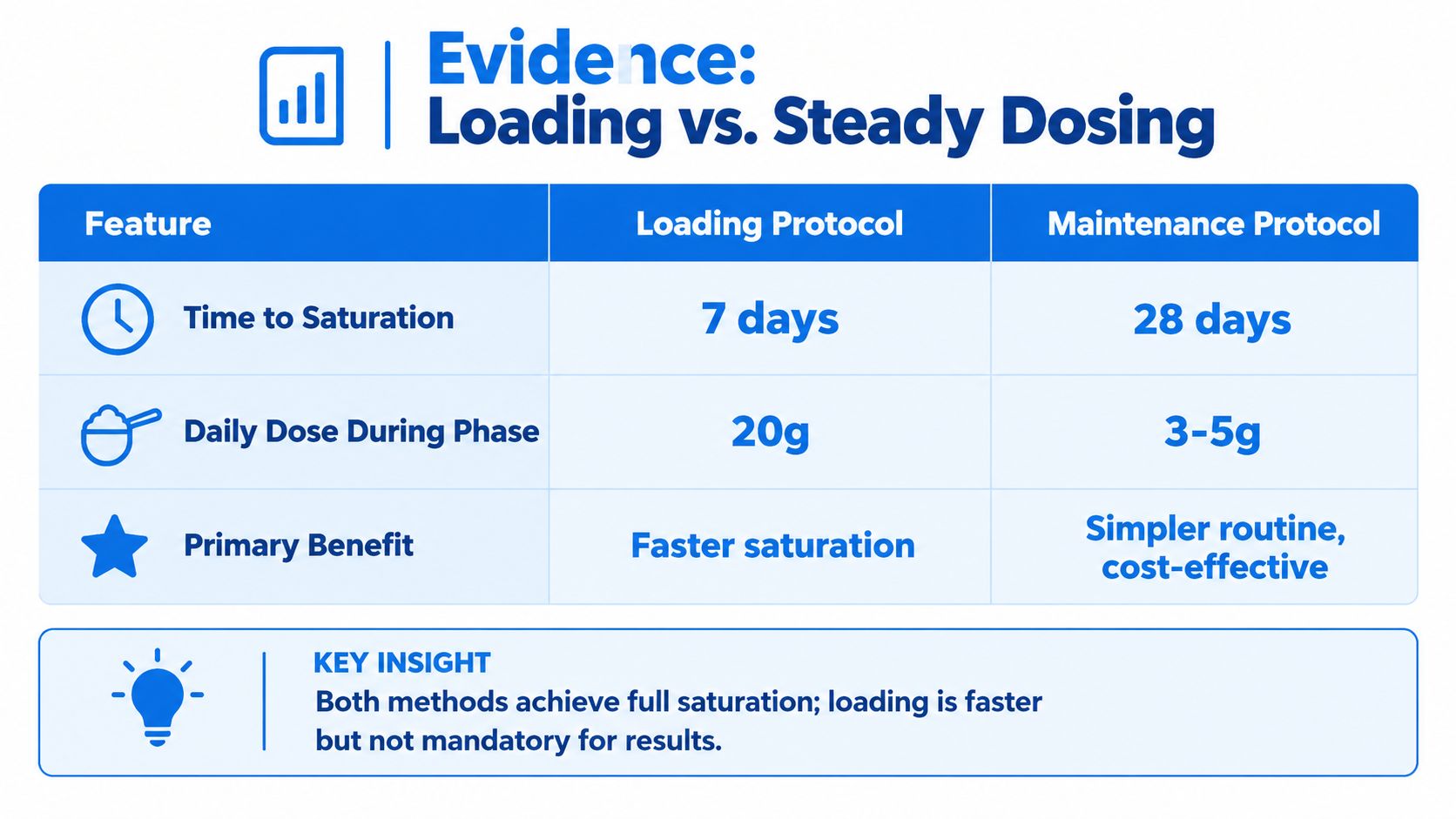
The key distinction is the time course, not a promise of a better final result. Loading can help you reach muscle saturation sooner, while a daily serving asks you to stay patient and let the process build gradually.
Once your stores are saturated, maintenance dosing helps keep them topped up. The exact clock time matters less than taking creatine consistently. Attaching it to breakfast, a post-workout shake, or your evening meal can make the habit easier to remember, whether you train at a downtown Toronto gym or in a home setup during a cold prairie evening.
Key takeaway: Loading changes how quickly you reach saturation. It isn't a mandatory step for everyone.
If you want a second plain-language explanation of the underlying process, SupplementSource.ca's guide on how creatine works is a useful companion.
What the Evidence Says About Loading Versus Steady Dosing
The evidence supports a nuanced answer. Loading can get creatine into the muscles more quickly, but faster saturation doesn't automatically mean better long-term training results.
A 2021 meta-analysis found that creatine's strength benefits were stronger in studies that included a loading phase. However, when researchers removed the loading studies, creatine no longer showed greater effects than placebo for chest press or leg press strength. You can review the analysis in the peer-reviewed meta-analysis.
That finding doesn't mean creatine is useless without loading. It means the comparison becomes harder to interpret when one group reaches saturation sooner than the other. If a study measures results early, the loading group has had more time at higher muscle creatine stores.
The timing issue matters
A practical way to read the evidence is to separate two questions:
- How quickly do stores rise? Loading is designed to accelerate that process.
- Does the initial speed guarantee a superior long-term outcome? The evidence doesn't support that conclusion.
This distinction matters for a Canadian athlete with a short runway before an event. If you need the protocol to work on a compressed timeline, faster saturation may be useful. If you're following a progressive lifting plan for the foreseeable future, a steady daily approach may fit just as well.
Research also raises a useful counterpoint about lean mass. A 2025 randomized trial reported that 5 grams per day increased lean body mass during a 7-day wash-in. Once resistance training began, both the creatine and placebo groups gained about 2 kilograms, with no further differences in lean body mass growth reported in that trial. The study is discussed in this Canada-relevant nutrition research report.
What this means on the gym floor
If you're expecting loading to create a permanently superior result, the research doesn't justify that expectation. Loading is better understood as a timeline choice.
If you're comparing supplements more broadly, a practical overview such as do supplements actually do anything can also help you separate realistic use cases from exaggerated marketing. With creatine, the strongest practical decision is simple: choose the schedule you can follow without turning your first week into a chore.
Loading Versus Daily Dosing Compared on Speed Comfort and Cost
The Canadian decision is usually less about whether loading can work and more about whether you need it quickly. Health Canada's workout supplement guidance recognises a loading phase of 15 to 20 grams daily for 5 to 7 days, a slower 3 to 5 gram approach for at least 4 weeks, and no loading phase for at least 4 weeks.
Here's how those paths compare in real life.
| Factor | Loading 15 to 20 g for 5 to 7 Days | Steady 3 to 5 g Daily |
|---|---|---|
| Speed | Reaches saturation sooner | Builds stores gradually |
| Daily routine | Requires several servings during the loading period | Usually fits a simple once-daily habit |
| Stomach comfort | Larger total intake may be harder for some people to tolerate | Smaller daily intake is often simpler |
| Travel and workdays | More servings to organise during the first week | Easier to pack and remember |
| Short-term cost | Uses more product during the initial phase | Uses less product during the initial phase |
| Best fit | A short timeline before a camp, tournament, or event | Long-term gym progress and routine building |
Loading makes sense for a deadline
Suppose you've registered for a training camp and want saturation sooner. Loading gives you a way to follow the faster Health Canada-permitted route, provided you divide the total across the day rather than treating it as one large serving.
Steady dosing makes more sense when your goal is to build strength over an open-ended training block. Beginners often benefit from removing unnecessary decisions. One daily serving is easier to pair with a meal, shaker, or morning routine than a high-intake schedule.
Comfort deserves a place in the calculation
A protocol that looks efficient on paper can become inefficient if it makes you uncomfortable or causes you to stop. Loading also creates a bigger short-term product demand, while steady dosing spreads use across time.
For Canadian shoppers, the final cost depends on the product, package size, brand, and current promotion. SupplementSource.ca offers a wide variety of creatine brands and categories, along with clearance deals, short-dated options, and overstock savings, so either approach can be matched to your budget without assuming that loading is automatically the better value.
Decision rule: Choose loading for speed. Choose steady dosing for simplicity, comfort, and a routine you can maintain.
How to Dose Creatine Correctly in Canada
Start by choosing one of the two practical paths. Don't combine them randomly or treat a missed serving as a reason to take an oversized amount later.
Option one uses loading
Health Canada's monograph sets the loading total at 15 to 20 grams per day for 5 to 7 days, and it sets a maximum single dose of 5 grams. That means a 20-gram day must be divided into multiple servings, not taken as one large scoop.
A simple example could look like this:
- Breakfast: 5 grams
- Lunch: 5 grams
- Post-workout or afternoon: 5 grams
- Evening meal: 5 grams
After the loading period, move to a maintenance dose. Health Canada allows 2 to 5 grams per day for maintenance in the relevant monograph guidance. Use the product label and the applicable directions for the product you purchase.
Option two skips loading
Take 3 to 5 grams daily and continue for at least 4 weeks, as Health Canada's monograph permits. A beginner might stir creatine monohydrate into a breakfast smoothie each morning. Someone training after work might keep the container beside their shaker and take it with their post-workout drink.
The timing doesn't need to become another performance puzzle. A meal or shake can help with habit formation, while taking it at the same time each day reduces the chance that a busy commute, hockey practice, or long shift knocks the routine off course.
Adjust the routine to your schedule
A weight-based loading option commonly discussed in the broader evidence base is about 0.3 grams per kilogram per day. For an 80-kilogram person, that works out to about 24 grams per day, which exceeds the Health Canada monograph's stated loading total and therefore shouldn't replace the Canadian monograph directions for a Canada-focused plan. The Canadian ceiling remains the more relevant framework for this article.
Keep fluids consistent across the day, especially when training in heated indoor facilities during winter. You don't need a complicated timing ritual. You need a repeatable system, a suitable creatine monohydrate product, and a plan you can follow on both training and rest days.
For practical preparation ideas, see SupplementSource.ca's guide on how to take creatine monohydrate. SupplementSource.ca also provides Canadian delivery, free shipping on orders over $99, and English and Français shopping support, which can be useful when you're organising a larger nutrition order.
Side Effects Tolerance and Who Can Skip Loading
Loading isn't automatically uncomfortable, but larger servings can be harder for some people to tolerate. Stomach upset, fullness, or digestive discomfort are the issues most likely to influence the decision, especially when someone takes the entire daily amount too close together.
Splitting the dose is the practical fix. Staying within the 5-gram maximum per serving during loading follows the Health Canada monograph and makes the schedule easier on the stomach than one large intake. If loading still doesn't feel good, switching to steady dosing is a reasonable response, not a failure.
Water retention can also confuse new users. Creatine increases stored water within muscle, which can make muscles feel or look fuller. That experience is different from saying that loading is necessary for long-term progress.
Who usually benefits from skipping it
A no-loading approach is especially practical for people who value a low-friction routine:
- Beginners: You can focus on learning movement technique, organising meals, and showing up consistently.
- Older adults: A smaller daily routine may be easier to fit alongside an established nutrition and training plan.
- Sensitive stomachs: Steady dosing avoids the larger short-term intake that can cause discomfort.
- Budget-conscious buyers: A slower protocol uses less product at the beginning.
- Long-term gym-goers: If your training has no immediate deadline, there's less reason to prioritise rapid saturation.
The 2025 trial discussed earlier adds useful context. During its initial wash-in, 5 grams per day increased lean body mass, but after resistance training began, the creatine and placebo groups both gained about 2 kilograms, and the trial reported no further difference in lean body mass growth. That result doesn't settle every question about creatine, but it supports a sensible view of loading as a convenience and timeline choice.
For a practical overview of tolerability and common questions, SupplementSource.ca's resource on creatine benefits and side effects keeps the discussion focused on everyday use. Follow the product directions, and if a specific health condition or medication makes supplementation a personal concern, ask a qualified healthcare professional for individual guidance.
Choosing Your Best Path and Next Steps in Canada
The answer to is creatine loading necessary is no. It's an available option, not a required opening move.
Choose the faster route when reaching saturation sooner matters for an upcoming camp, tournament, or tightly scheduled training phase. Choose steady dosing when you're building a lasting routine, want fewer daily servings, prefer a gentler start, or don't want to spend your first week thinking about creatine.
Your practical checklist is short:
- Need speed: Use the Health Canada-permitted loading structure and split servings.
- Want simplicity: Take a steady daily serving and stay consistent.
- Have stomach concerns: Start with the lower-intake approach.
- Want better value: Compare package sizes, brands, clearance deals, short-dated options, and overstock savings.
SupplementSource.ca is a Canadian online supplement store with low prices, fast reliable shipping, a broad selection of brands and categories, and tools such as TDEE and training calculators. You can pair creatine with a sensible workout plan, track your lifts, and use nutrition tools to support your wider goal, whether that's learning how to build muscle for beginners or maintaining strength through your 40s and beyond.
Visit SupplementSource.ca to compare creatine monohydrate options, Canadian pricing, clearance deals, and a wide range of nutrition products. Pick the loading or steady-dosing route that fits your timeline, start your daily habit, and let consistent training do the rest.