

How Many Carbs on Keto? A Canadian's Guide to Your Daily Limit
So you're jumping into the world of keto and have the big question on your mind: "how many carbs can I actually have?" The answer for most people is surprisingly simple: aim for 20 to 50 grams of net carbohydrates per day. This range isn't just a random number; it's the proven sweet spot for nudging your body into a metabolic state called ketosis, where it starts burning fat for fuel instead of sugar. It’s a big shift, but a totally achievable one.
Your Keto Starting Point: The 20-50 Gram Rule
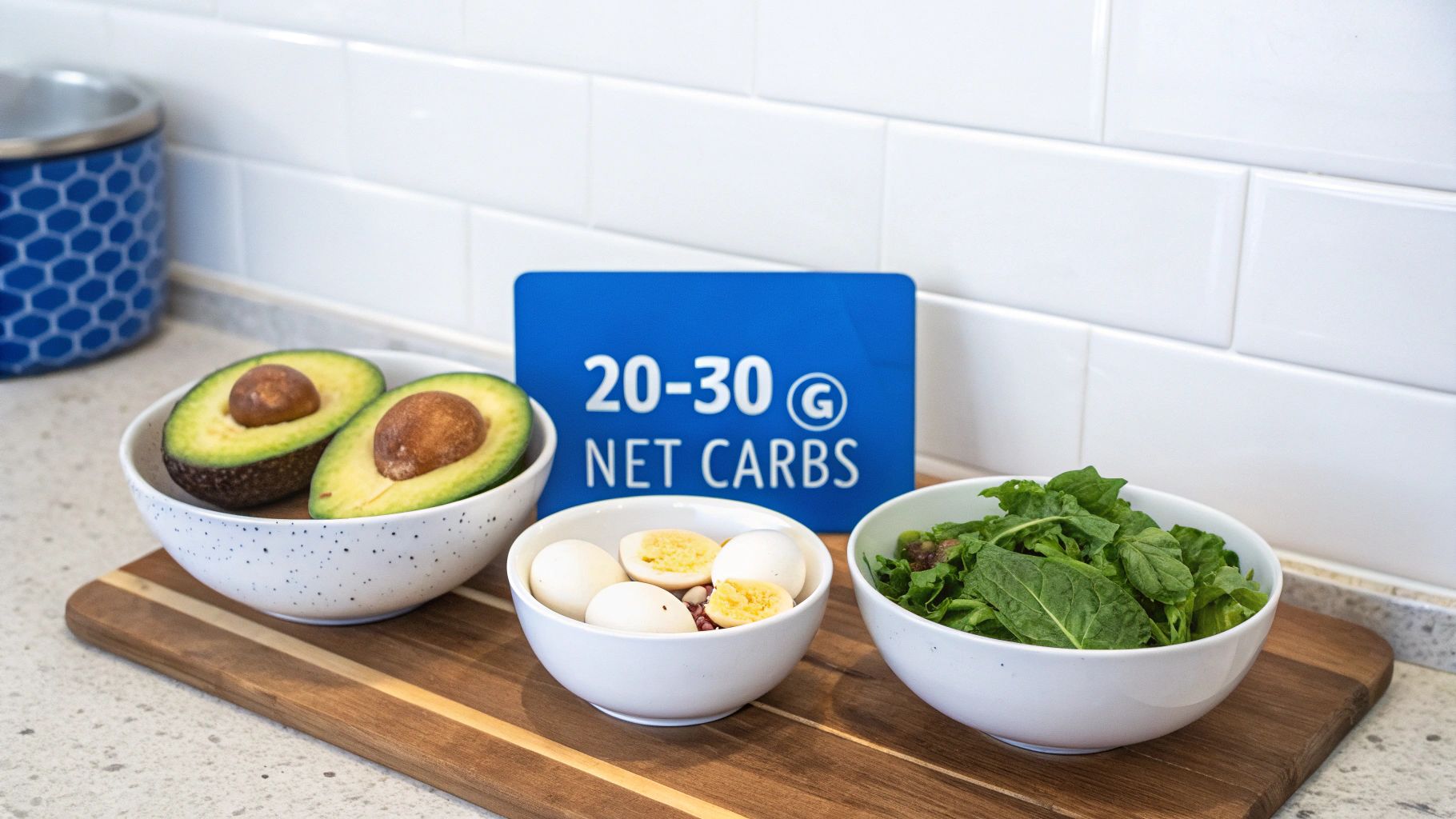
Think of that 20–50 gram window as your universal starting line. It's strict enough to flip your body's metabolic switch but flexible enough that you can still build satisfying, delicious meals from whole foods. For the average Canadian, this is a major departure from business as usual.
To really put this into perspective, let's look at how most Canadians eat. The typical diet gets nearly half of its daily energy from carbs. A ketogenic diet, as defined by sources like Alberta Health Services, involves getting less than 10% of your energy from carbs. Meanwhile, the average Canadian adult pulls about 46-48% of their calories from them.
Here’s a quick comparison to see just how different keto is from a standard diet.
Standard Daily Carb Limits Keto vs Typical Canadian Diet
| Dietary Approach | Typical Daily Carb Intake (grams) | Percentage of a 2,000-Calorie Diet |
|---|---|---|
| Standard Ketogenic Diet | 20–50 grams | 4–10% |
| Low-Carb Diet | 50–130 grams | 10–26% |
| Typical Canadian Diet | 230–350+ grams | 46–70% |
This massive difference is exactly why keto can be so effective—it forces a fundamental change in how your body generates energy. You're not just tweaking things; you're changing the fuel source entirely.
Why This Range Works
So, what's the magic behind this specific number? The whole point of the ketogenic diet is to drain your body’s stored sugar (called glycogen). Once those reserves are empty, your body has no choice but to find an alternative fuel. That’s when your liver starts converting fat into molecules called ketones, which become your new primary energy source.
This metabolic switch comes with some serious perks:
- Stable Energy Levels: By running on fat, you can say goodbye to the energy spikes and crashes that come with high-carb meals.
- Feeling Fuller, Longer: High-fat and moderate-protein meals are incredibly satiating, which often leads to naturally eating fewer calories without feeling deprived.
- Improved Mental Clarity: Many people report sharper focus and less "brain fog" once their brain adapts to running on ketones.
The concept is simple: by starving your body of its preferred fuel (carbs), you force it to become incredibly efficient at burning its stored fuel (fat). The 20–50 gram limit is the trigger for that powerful metabolic shift.
Of course, to hit that target, you need to track your carbs accurately. In the next section, we’ll dive into the single most important concept for doing that: net carbs. Master this, and hitting your daily goal will be a breeze.
Why Net Carbs Are the Only Number That Matters
If you've ever stared at a nutrition label feeling a bit overwhelmed, you're not alone. When you're just starting keto, the numbers can feel like a lot, but there's really only one you need to laser-focus on: net carbs. For now, forget the rest. This is the figure that truly determines whether you get into ketosis and stay there.
A good way to think about it is like your paycheque. The 'total carbs' on a label is your gross pay—that big, impressive number before all the deductions. But net carbs are your take-home pay; it's what actually hits your bank account and impacts your body's bottom line.
The Simple Formula for Keto Success
Figuring out net carbs is surprisingly simple. Your body can't fully digest or absorb certain kinds of carbohydrates, specifically fibre and some sugar alcohols. Since they don't spike your blood sugar or insulin levels, you can subtract them from the total. They get a free pass.
Here’s the daily formula you’ll live by:
Total Carbohydrates – Fibre – Certain Sugar Alcohols = Net Carbs
This little piece of math is your key to unlocking a much wider, more enjoyable keto lifestyle. It’s the reason you can eat things like avocados, raspberries, and even specialty keto snacks without knocking yourself out of ketosis.
For example, a handful of raspberries might have 15 grams of total carbs, but it's also packed with 8 grams of fibre. Do the math (15 - 8), and you're left with only 7 grams of net carbs. That’s a massive difference compared to a slice of bread, which has a similar total carb count but almost zero fibre to offset it.
Reading Labels Like a Pro
Let's look at a couple of real-world examples you'd find in any Canadian grocery store.
-
Product A (Keto Bread): Total Carbs: 12g, Fibre: 9g.
- Calculation: 12g - 9g = 3g Net Carbs per slice.
-
Product B (Low-Carb Yogurt): Total Carbs: 10g, Fibre: 2g, Sugar Alcohols: 5g.
- Calculation: 10g - 2g - 5g = 3g Net Carbs per serving.
All of a sudden, foods that looked like they were off the table are perfectly fine. This is why getting a handle on net carbs is so empowering—it gives you back your freedom and flexibility. It's also why so many products at SupplementSource.ca, like keto-friendly protein bars and shakes, are loaded with fibre. They deliver great taste while keeping the net carbs incredibly low.
This principle doesn't just apply to packaged goods; it's true for whole foods too. A pure fat like olive oil, for instance, has zero carbs and therefore no impact on blood sugar, making it a keto all-star. You can check out more on olive oil's glycemic index and carb content to see exactly why it's a staple in low-carb cooking.
By focusing only on the carbs that count, you make keto a sustainable, long-term habit. You stop seeing a list of restrictions and start seeing a world of possibilities. That daily target of 20–50 grams becomes a simple puzzle to solve each day, not an impossible mountain to climb.
Finding Your Personal Keto Carb Limit
That standard 20–50 gram range is a brilliant starting point, but let's be honest—life isn't one-size-fits-all. Your perfect daily carb limit depends entirely on your lifestyle, your goals, and even where you live in Canada.
Think of this as your personal coaching session to dial in the exact number that will make keto work for you, not the other way around. The key is to see keto less as a rigid rulebook and more as a flexible framework. The number that keeps you in ketosis can vary based on your body's unique demands.
Tailoring Your Carbs To Your Lifestyle
Let’s look at a few relatable Canadian scenarios to see how this plays out in the real world. A person’s ideal carb intake can be very different depending on their daily routine.
- Sarah, the Toronto Office Worker: Sarah spends most of her day at a desk, and her main goal is weight loss. For her, sticking to the lower end of the keto spectrum—around 20–30 grams of net carbs—is ideal. This stricter limit helps her body become highly efficient at burning stored fat for energy.
- Mike, the Calgary Construction Worker: Mike is on his feet all day, doing physically demanding work. He needs sustained energy to get through long shifts. His body will burn through fuel much faster, so he might find his sweet spot is closer to 40 grams of net carbs.
- Isabelle, the Montreal CrossFit Athlete: Isabelle trains hard and needs fuel for intense workouts. Pushing her net carb intake towards the upper limit of 50 grams, or even slightly more on training days, can help fuel her performance. This approach is often called a Targeted Ketogenic Diet (TKD).
As you can see, the answer to "how many carbs on keto" isn't a single number. It’s a target you adjust based on your life’s demands.
To help visualize the core calculation you'll be making daily, this simple flowchart breaks down how to determine your net carbs from a food label.
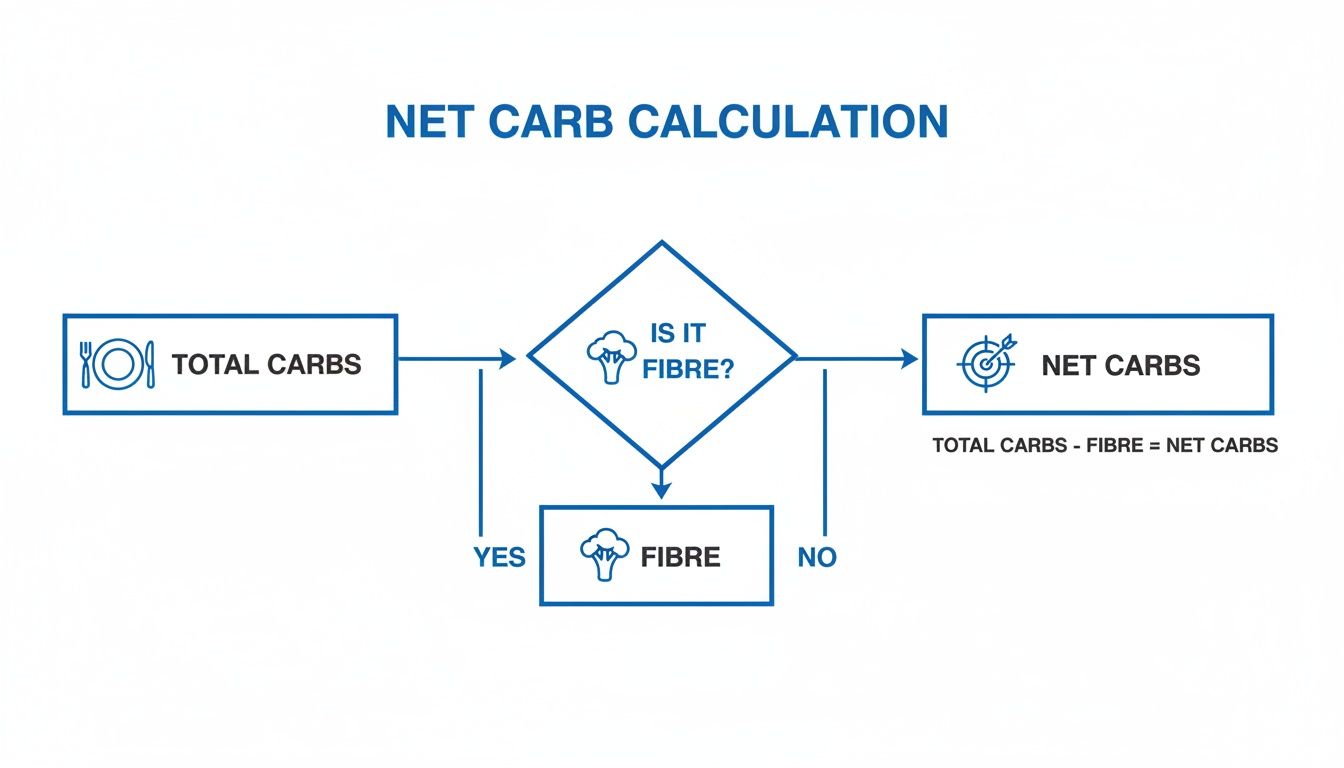
It’s a simple but powerful formula: your net carbs are what’s left after you subtract indigestible fibre from the total carb count.
A Step-by-Step Guide To Your Number
Ready to find your personal carb limit? The best way is to start with a baseline and adjust from there. This systematic approach takes the guesswork out of the equation.
- Start at the Baseline (20g): For the first one to two weeks, commit to 20 grams of net carbs per day. This is the surest way to get your body into ketosis and become fat-adapted.
- Slowly Increase by 5g: After two weeks, if you’re feeling good, add 5 grams of net carbs to your daily total, bringing you to 25g. Hold this for a full week and monitor how you feel.
- Assess and Repeat: Are you still feeling energetic? Is your appetite under control? Are you still seeing progress toward your goals? If the answer is yes, you can try adding another 5g the following week.
- Find Your Threshold: Continue this process until you notice negative effects, like energy dips, increased cravings, or stalled weight loss. Once you hit that point, dial it back by 5g. That’s your personal carb ceiling.
Key Insight: Your personal carb limit is the highest number of net carbs you can eat daily while still maintaining ketosis and feeling your best. This is your sustainable sweet spot.
To make this process of finding your limit much easier, it’s worth researching the best app to track food for your goals. Precise tracking is a game-changer.
Remember, this number might change over time. A cold Canadian winter where you’re less active might mean a lower carb intake, while a summer spent hiking might allow for more. The beauty of keto is its adaptability—once you learn to listen to your body, you can make it work for any season of life.
What 25 Grams of Net Carbs Actually Looks Like
Knowing your carb limit is one thing, but picturing it on your plate is a whole different ball game. The number "25" can feel abstract, even a bit intimidating, leading many people to think keto is all about eating bland, restrictive meals. Let's bust that myth right now.
A 25-gram net carb day isn’t about starving yourself; it's about making smart, satisfying choices. To prove it, let’s walk through a sample day of eating using foods you can find at any Canadian supermarket. You’ll see just how delicious and filling keto can be.
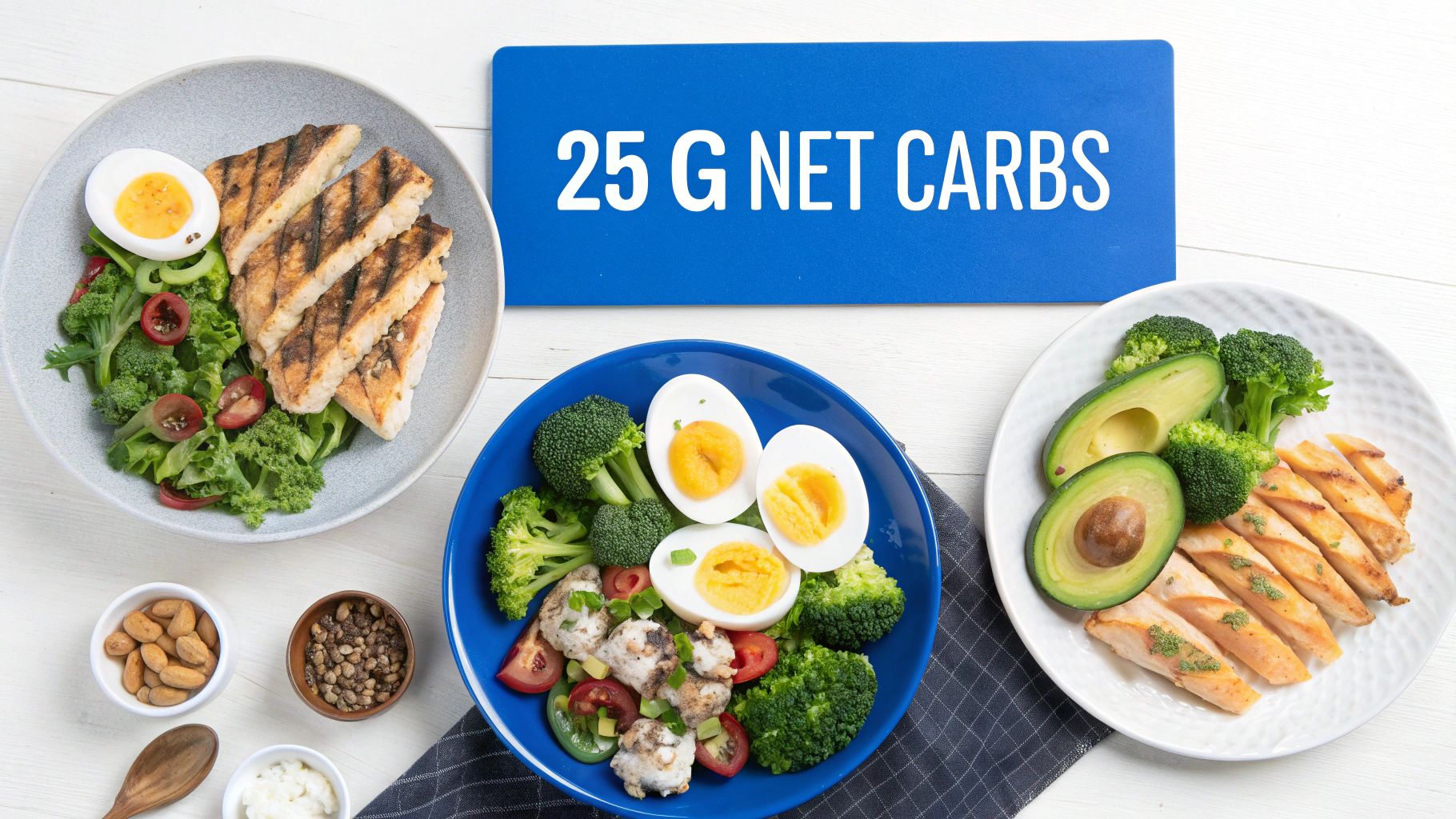
A Sample 25-Gram Keto Day
This meal plan is built around whole foods that are high in healthy fats, moderate in protein, and naturally low in carbs. It’s designed to keep you full and energized, all while staying comfortably within your keto targets.
-
Breakfast (Approx. 4g Net Carbs):
- 2 large eggs cooked in butter
- Half a medium avocado, sliced
- Why it works: This is a classic keto breakfast for a reason. It's packed with healthy fats and protein, setting you up for stable energy that lasts for hours. No mid-morning crash here.
-
Lunch (Approx. 8g Net Carbs):
- A large bowl of mixed greens (spinach, arugula)
- 150g grilled chicken breast
- Cucumber, bell peppers, and a sprinkle of cheese
- A creamy, high-fat dressing (like ranch or Caesar)
- Why it works: A big salad delivers essential micronutrients and fibre, while the chicken and dressing provide the fat and protein needed to make it a truly substantial meal.
-
Dinner (Approx. 7g Net Carbs):
- 150g baked salmon with a lemon-dill butter sauce
- A generous serving of roasted broccoli tossed in olive oil
- Why it works: Salmon is rich in omega-3 fatty acids, and broccoli is a fantastic low-carb, high-fibre vegetable. Roasting brings out an amazing flavour without adding any carbs.
Believe it or not, this entire day of delicious food adds up to only 19 grams of net carbs, leaving you with a comfortable buffer. You could easily add a handful of nuts, some berries, or even a keto-friendly dessert without breaking a sweat.
Handling Hunger and Busy Schedules
So, what happens during that afternoon slump or on a day you’re rushing between work and the gym? That's where having a smart snack becomes an absolute game-changer, and it’s why that carb buffer is so useful.
A high-quality, low-carb protein bar can be a lifesaver. Many are designed specifically for the keto diet, containing only 2-4 grams of net carbs per bar. Grabbing one from your gym bag is a simple way to crush cravings and stay on track without derailing your progress. If you're looking for great options, check out our guide to the best low-carb protein bars available right here in Canada.
The goal isn't just hitting a number; it's building a sustainable lifestyle. By planning satisfying meals and having smart snacks ready, you turn "how many carbs on keto" from a question into a confident daily practice.
It's also important to remember just how targeted the keto diet is. The Heart and Stroke Foundation of Canada notes that a general "low-carb" diet can contain up to 100 grams of carbs daily. Keto's strict target of under 50 grams is significantly lower, which is precisely why it's so effective at shifting your metabolism into high gear. You can learn more about their perspective on carbs here.
This real-world example shows that a 25-gram limit is far from restrictive. It’s a framework for eating delicious, nutrient-dense foods that keep you feeling your absolute best.
Can Athletes Perform on Keto? Adjusting Carbs for Performance
For active Canadians, it’s the million-dollar question: can I actually perform at my best on so few carbs? It doesn't matter if you're a long-distance runner training through a frosty Edmonton winter or a Vancouver bodybuilder chasing a new personal best on leg day—performance is everything. And the answer is a definite yes, but you need the right strategy.
When you first jump into keto, your body has to go through an adaptation phase. Don't be surprised if your high-intensity performance takes a temporary dip. Your body is literally learning to switch its main fuel source from glucose (carbs) to fat. Once you're fully fat-adapted, though, your body becomes an incredibly efficient machine at using stored fat for sustained, low-to-moderate intensity exercise. Think long runs, cycling, or steady-state cardio—you might find your endurance is even better than before.
Going Beyond the Standard Keto Diet
But what about those explosive, high-intensity efforts? Things like sprinting, heavy lifting, or a gruelling CrossFit WOD. For those, your muscles still love a quick-burning fuel like glucose. This is where a couple of advanced ketogenic strategies come into play, letting you have your cake and eat it too (metaphorically, of course).
These aren't for beginners, but for seasoned athletes, they can be a total game-changer. The two most popular methods are the Targeted Ketogenic Diet (TKD) and the Cyclical Ketogenic Diet (CKD).
-
Targeted Ketogenic Diet (TKD): Think of this as the precision approach. You strategically eat 15–30 grams of fast-acting, easily digestible carbs about 30–60 minutes before a really intense workout. This gives you a quick shot of glucose to fuel your muscles right when they need it, but it's not enough to refill your liver's glycogen stores. The result? You drop right back into ketosis shortly after your workout.
-
Cyclical Ketogenic Diet (CKD): This is a more advanced plan, often used by bodybuilders or competitive athletes. It involves sticking to a strict keto diet for 5–6 days a week, followed by 1–2 days of a much higher-carb "refeed." That refeed day is all about intentionally refilling muscle glycogen to power you through another week of punishing workouts.
What This Looks Like for Canadian Athletes
Let's make this real. Remember that Vancouver bodybuilder? On a brutal leg day, he might use a TKD approach. A small scoop of dextrose or a fast-acting carb powder right before he even looks at the squat rack gives him that explosive power for his heavy sets, without knocking him out of ketosis for long.
Or how about a hockey player in Montreal during the off-season? They could use a CKD protocol. They'd time their carb-up day for a Saturday to fuel their most demanding training sessions on Sunday and Monday, then slide back into strict keto for the rest of the week to stay lean.
Let's be clear: these advanced strategies aren’t about cheating. They’re about strategically using carbs as a performance tool. You get to keep the metabolic benefits of ketosis while still fuelling the high-intensity work you need to build muscle and strength.
No matter which approach you take, there’s one thing that is absolutely non-negotiable for any active person on a low-carb diet: electrolytes. When you slash carbs, your body flushes out water, and a ton of essential minerals like sodium, potassium, and magnesium go with it. This is a fast track to cramps, fatigue, and a serious drop in performance.
Honestly, supplementing with a high-quality electrolyte powder is one of the smartest moves you can make. It’s a dead-simple, reliable way to stay hydrated and keep your muscles firing on all cylinders. Here at SupplementSource.ca, we have a massive selection of electrolyte formulas—often at the lowest prices in Canada—that we can ship right to your door, making sure you never have to train at less than 100%.
Essential Supplements for a Smooth Keto Transition

Starting a ketogenic diet is a huge step, but let's be honest—those first few weeks can feel a bit rough. As your body makes the big switch away from carbs, it flushes out a ton of water. The problem? Crucial minerals get flushed out right along with it.
This sudden imbalance is exactly what causes the dreaded "keto flu," leaving you feeling tired, foggy, and generally run down.
But here's the good news: this is completely avoidable with the right supplement strategy. Don't think of these as "extras." Think of them as your essential toolkit for a smooth, fast, and painless transition into ketosis.
Your Keto Flu Survival Kit: Electrolytes
Electrolytes are the absolute, non-negotiable foundation for a good start on keto. When your insulin levels drop (a key goal of keto), your kidneys start excreting sodium, potassium, and magnesium way faster than usual. You have to be proactive about putting them back in.
- Sodium: This is the big one. Forget everything you've ever heard about cutting back on salt; on keto, you need more. Add a generous pinch of sea salt to your water or sip on some quality bone broth during the day.
- Potassium: Super important for preventing muscle cramps and that heavy feeling of fatigue. While you can get potassium from keto-friendly foods like avocados and leafy greens, it's often tough to get enough from diet alone, especially at first.
- Magnesium: This mineral is your best friend for better sleep, muscle relaxation, and energy production. A magnesium glycinate or citrate supplement before bed can be a game-changer.
While getting these from food is great, trying to balance them perfectly every day can be a massive headache. This is where a high-quality electrolyte powder becomes your secret weapon. It's simply the easiest and most reliable way to cover your bases and keep the keto flu from ever showing up.
Key Takeaway: Electrolytes aren't just a nice-to-have on keto; they're a requirement for feeling your best. Actively managing your sodium, potassium, and magnesium intake is the single most effective thing you can do to avoid feeling rundown in the beginning.
MCT Oil for an Energy and Ketone Boost
Once you've got your electrolytes dialled in, the next thing to consider is MCT oil. MCTs, or Medium-Chain Triglycerides, are a unique type of fat that your body can convert into ketones almost instantly.
Adding a spoonful to your morning coffee or smoothie gives you a quick, clean source of energy that your brain and body can use right away. It's a powerful tool for sharpening your focus and making the shift into full ketosis feel much quicker and smoother. Think of it as giving your body a direct shot of keto fuel.
Below is a quick-glance table of the key supplements that can make your keto journey a whole lot easier.
Key Keto Support Supplements and Their Roles
| Supplement | Primary Role on Keto | Good Food Sources | Why Supplementation Helps |
|---|---|---|---|
| Sodium | Prevents dehydration, maintains blood pressure | Salted nuts, pickles, bone broth, cured meats | Rapidly depleted as the body flushes water; needs active replacement to avoid fatigue and headaches. |
| Potassium | Supports muscle function, prevents cramps | Avocado, spinach, salmon, mushrooms | Difficult to consume enough through food alone without exceeding carb limits, especially for beginners. |
| Magnesium | Aids in sleep, muscle relaxation, energy | Almonds, pumpkin seeds, dark leafy greens | Often deficient in modern diets; keto can exacerbate this, leading to cramps and poor sleep. |
| MCT Oil | Provides quick energy, boosts ketone levels | Coconut oil, palm kernel oil | Bypasses normal fat digestion for instant ketone production, sharpening focus and reducing carb cravings. |
These supplements aren't just about avoiding the bad stuff; they're about helping you feel great right from the start.
At SupplementSource.ca, we know how vital these tools are for our fellow Canadians kicking off their keto journey. We've got a massive selection of electrolyte powders and premium MCT oils, all at the lowest prices you'll find in Canada. Plus, with our fast shipping, you can get your keto survival kit delivered right to your door before the first hint of brain fog sets in.
Getting started on a new way of eating can feel like a lot, but having the right support makes all the difference. For more foundational knowledge, you might find our guide on essential supplements for beginners helpful as you build your new routine.
Keto Carb Limits: Your Questions Answered
Even with the best plan, you're bound to run into some questions. It happens to everyone. Let's tackle some of the most common hurdles Canadians face when dialing in their daily carb count. Think of this as your go-to guide for those "oops" or "what if" moments.
What Happens If I Accidentally Go Over My Carb Limit?
First things first: don't panic. One meal or one accidental slip-up won't derail all your hard work.
What happens is pretty straightforward—your body will likely get kicked out of ketosis temporarily. It sees the sudden rush of glucose and naturally prioritizes burning that off first. The key is to simply get right back on track with your very next meal. No big deal.
Drink some extra water, maybe add a pinch of sea salt to help with hydration, and just return to your usual keto foods. Your body is smart; it will burn through those extra carbs and shift back into ketosis, usually within a day or two. Remember, this is all about consistency, not perfection.
How Do I Spot Hidden Carbs in Foods?
This is a big one. Hidden carbs are sneaky and can pop up in sauces, dressings, and pretty much any processed food. Your best defence is to become a label detective.
Always flip the package over and check the nutrition facts. Pay close attention to "Total Carbohydrates" and "Fibre" so you can figure out the net carbs for yourself. Be especially wary of anything labelled "low-fat," as companies often pump them full of sugar to make them taste better.
Some common culprits to watch out for include:
- Condiments: Ketchup, BBQ sauce, and a surprising number of salad dressings.
- Processed Meats: Some sausages, bacon, and deli meats use sugar or carb-heavy fillers.
- Dairy Alternatives: Flavoured yogurts and sweetened nut milks can pack a sugary punch.
Can I Drink Alcohol on a Keto Diet?
You absolutely can, but you have to be smart about your choices. A lot of alcoholic drinks are basically sugar bombs.
Your safest bets are clear spirits like vodka, gin, rum, and tequila, which have zero carbs on their own. Just be sure to mix them with soda water or another zero-carb mixer. Dry wines, both red and white, are also pretty good options, usually landing between 3-5 grams of carbs per glass. The drinks to avoid are beer, sweet wines, and sugary cocktails—they can blow your entire daily carb budget in one go.
It's also worth remembering that your body puts everything on hold to process alcohol. That means fat-burning gets paused until the alcohol is cleared from your system, which can temporarily slow things down.
For many Canadians, keeping that carb count low is also a critical tool for managing health conditions. Staying under that 50g/day mark, for instance, can be a game-changer for those with type 2 diabetes. A position paper from Diabetes Canada actually highlights clinical trials showing that a sharp carb reduction can lead to significant improvements in blood sugar control, often reducing the need for medication. You can explore the full position paper from Diabetes Canada for more details.
Here at SupplementSource.ca, our job is to make your health journey as smooth as possible. Whether you need keto-friendly snacks to beat cravings, essential electrolytes to stay balanced, or high-quality MCT oil to fuel your goals, we've got you covered. We're proud to offer Canada's lowest prices and fast, reliable shipping. Explore our huge selection of keto-friendly products and start building your ultimate support kit today!